Showing posts with label for. Show all posts

Tuesday, September 3, 2013

Automatic Switch for Batteries

Nowadays the batteries are gaining more and more power, being the only components that fail to provide energy for portable electronic devices. The evolution is rapid, leading manufacturers electronic equipment to attempt to minimize the consumption of their products so that they can operate for several hours using simple batteries trade. In spite of the efforts of manufacturers, the device will absorb a zero power not yet invented. Thus, both small and if the current device is mathematically certain that at some point, after a few hours, days or ethdomades, the battery-drain .

 Automatic Switch for Batteries  Circuit diagram

The purpose of the circuit will describe below, is to keep alive batteries for the maximum time, minimizing unnecessary consumption. Taking a brief look at the circuit, you notice that the few parts that are can be integrated into any device powered by a battery of 9 V. The main trait is that allows current to flow to the load for a minute, since you pressed the switch S1. After this time automatically cuts off the battery connection. The peak current during switching is 20 mA, price satisfactory for most devices that work with batteries, this nominal voltage.

The heart of the construction is a Darlington type transistor PNP (T1), which is driven in a state of conduction through the pressing switch S1. The small current thaoio, which is due to the high rate of aid, makes able to remain in this condition even for relatively small values ??of the capacity of capacitor C 1 (Around 100 MF). The resistance A3 limits the charge current of the capacitor, thus ensuring long life pressing the switch.

Resistance A1 and A2, in conjunction with the capacitor C 1, determine the period allowed to flow, flow to the load. After this time, the T1 is driven in the state cutoff, a condition ensured by R1. In this design, the placement of a diode to protect from any reverse polarity would be an unnecessary luxury, since the maximum reverse voltage that can accept darlington between thasis and emitter (UBE) is equal to 10 V.
Read More..

Thursday, August 15, 2013

Circuit modifications for operating 150 LEDs


Parts List

R1 = 220 Ohms, 1/2 watt
R2 = 100Ohms, 2 watts,
RL = All 22 Ohms, 1/4 watt,
C1 = 100uF/25V,
D1,2,3,4,6,7,8 = 1N5408,
D5 = 1N4007
T1 = AD149 or similar,
Transformer = 0-6V, 500mA

Read More..

Thursday, August 8, 2013

Delayed switch for Bedroom lamp

Here I have introduce a new circuit through this you can switch off your bed room lamp with some delay.so I suppose this may be so useful circuit for you.and also after attaching a relay for this circuit you can use this as a delay circuit.This gives 15 second delay

Parts:

C1 330nF 400V Polyester Capacitor

C2 100µF 25V Electrolytic Capacitor

C3,C5 10nF 63V Polyester or Ceramic Capacitors

C4 10µF 25V Electrolytic Capacitor

R1 470R 1/2W Resistor

R2 100K 1/4W Resistor

R3 1M5 1/4W Resistor

R4 1K 1/4W Resistor

D1,D2 1N4007 1000V 1A Diodes

D3 BZX79C10 10V 500mW Zener Diode

D4 TIC206M 600V 4A TRIAC

Q1 BC557 45V 100mA PNP Transistor

IC1 7555 or TS555CN CMos Timer IC

SW1 SPST Mains suited Switch

Note

# The delay time can be changed, changing R3 and/or C4 values.
Taking C4=10µF, R3 increases timing with approx. 100K per second ratio. I.e. R3=1M Time=10 seconds, R3=1M8 Time=18 seconds. Do test and see it.

Read More..

Friday, July 12, 2013

Voltage Tester for Model Batteries

With a suitable load, the terminal voltage of a NiCd or lithium-ion battery is proportional to the amount of stored energy. This relationship, which is linear over a wide range, can be used to build a simple battery capacity meter. 

Circuit Image :
 Voltage Tester for Model Batteries Image
Voltage Tester for Model Batteries Circuit Image 

This model battery tester has two functions: it provides a load for the battery, and at the same time it measures the terminal voltage. In addition, both functions can be switched on or off via a model remote-control receiver, to avoid draining the battery when it is not necessary to make a measurement. The load network, which consists of a BC517 Darlington transistor (T2) and load resistor R11 (15 Ω /5 W), is readily evident. When the load is active, the base of T1 lies practically at ground level. Consequently, T1 conducts and allows one of the LEDs to be illuminated. 

Circuit Diagram :
Voltage Tester for Model Batteries-Circuit Diagram
Voltage Tester for Model Batteries Circuit Diagram

The thoroughly familiar voltmeter circuit, which is based on the LM3914 LED driver, determines which LED is lit. The values of R6 and R7 depend on the type and number of cells in the battery. The objective here is not to measure the entire voltage range from 0 V, but rather to display the portion of the range between the fully charged voltage and the fully discharged voltage. Since a total of ten LEDs are used, the display is very precise. For a NiCd battery with four cells, the scale runs from 4.8 V to 5.5 V when R6 = R7 = 2 kΩ. The measurement scale for a lithium-ion battery with two cells ranges from 7.2 V to 8.0 V if R6 = 2 kΩ and R7 = 1 kΩ. 

For remote-control operation, both jumpers should be placed in the upper position (between pin 1 and the middle pin). In this configuration, either a positive or negative signal edge will start the measurement process. A positive edge triggers IC1a, whose output goes High and triggers IC1b. A negative edge has no effect on IC1a, but it triggers IC1b directly. In any case, the load will be activated for the duration of the pulse from monostable IC1b. Use P12 to set the pulse width of IC1a to an adequate value, taking care that it is shorter than the pulse width of IC1b. 

If the voltage tester is fitted into a remote-controlled model, you can replace the jumpers with simple wire bridges. However, if you want to use it for other purposes, such as measuring the amount of charge left in a video camera battery, it is recommended to connect double-throw push-button switches in place of JP1 and JP2. The normally closed contact corresponds to the upper jumper position,while the normally open contact corresponds to the lower position.

Parts :
Resistors:
R1,R2 = 47kΩ
R3 = 100kΩ
R4 = 500kΩ
R5 = 1kΩ
R6,R7 = see text (1% resistors!)
R8 = 1kΩ5
R9 = 1kΩ2
R10 = 330Ω
R11 = 15Ω 5W
R12 = 15kΩ
P1 = 100kΩ preset
Capacitors:
C1 = 10nF
C2 = 100nF
Semiconductors:
D1-D10 = LED, red, high effi-ciency
T1 = BC557
T2 = BC517
IC1 = 74HC123
IC2 = LM3914AN
Miscellaneous:
PC1,PC2,PC3 = solder pin
JP1,JP2 = jumper or pushbutton

PCB Layout :
B. PCB Laout
Voltage Tester for Model Batteries PCB Layout
 
 
Streampowers
Read More..

Saturday, April 13, 2013

SW Converter for Digital AM Car Radio

This circuit is purposely offered with many bathroomse ends (not actually, of course) to stimulate experimenting with RF circuitry at a small outlay. Looking at the circuit diagram you could additionally recognize a modified model of the SW Converter for AM Radios described in different situations in that issue. The changes had been necessary to make the circuit compatible with a digital quite than analogue AM car radio. The main distinction between digital AM radios and their all-analogue predecessors is that tuning is in 9 kHz (some-times 4.5 kHz steps) in compliance with the international frequency allocation for the band. Obviously, that exact step dimension, fascinating as it can be on MW, is a stumbling block if you want to use a digital AM receiver together with a frequency step-up converter for SW, where chaos reigns and there isn't any fastened step dimension. The first try was once to make the crystal oscillator variable through about 5 kHz each and every approach.
 
Circuit diagram :
SW Converter for Digital AM Car Radio Circuit Diagram
 
Unfortunately, regardless of serious efforts, the crystal could not be pulled more than 1 or 2 kHz so some different resolution had to be found. After finding out the NE/SA602/612 informationsheet, it was once found that a variable LC based totally oscillator was once one of the best different. The circuit labored after winding a resonant LC circuit and including a zero.1 µF sequence capacitor to dam the DC element on pin 6 of the NE602 (612). When the tuning used to be found to be a bit sharp with the original capacitor, a simple bandspread (or advantageous tuning) characteristic used to be added via shunting the LC resonant circuit with a lightly loaded 365 pF tuning capacitor (C10) which, like the principle tuning counterpart, C8, was once ratted from an outdated transistor radio. The tuning coil, L1, consists of 8 to 10 turns of 0.6-0.8mm dia. enamelled copper wire (ECW) on a 6-8 mm dia. former with out a core. With this coil, frequency protection shall be from about 4 MHz to 12 MHz or so. Details on Tr1 may be discovered in the referring article.
 
Note that no tuning capacitor is used on the secondary — the input stray capacitance of the NE602 (612) does the trick. A BFO (beat frequency oscillator) was once delivered to let SSB (single sideband) signals to be received. The BFO built round T1 is inconspicuous, has a heap of output and that is steady enough to automobilery an SSB signal for a few minutes with out adjustment. The BFO frequency is tuned with C3. Tr2 is a ready-made four55 kHz IF transformer whose inner capacitor was once first crushed after which eliminated with pliers. When S2 is closed the BFO output sign is solely superimposed on the NE602 (612) IF output to the MW radio. The converter will have to be built into a steel box for shielding. If you in finding that the BFO provides too much output, disconnect it as steered in the circuit diagram and let stray coupling do the work. Sensitivity, even on a 1-metre size of automotive radio aerial, is quite superb. Bearing in mind that many of the main international SW broadcasting stations like Radio NHK Japan, Moscow, BBC and many others.) generate enough power to ensure that you are going to hear them, it's nonetheless kind of thrilling to pay attention to such signals for the first time in your automobile radio. 


http://www.ecircuitslab.com/2012/02/sw-converter-for-digital-am-car-radio.html
Read More..

Monday, April 8, 2013

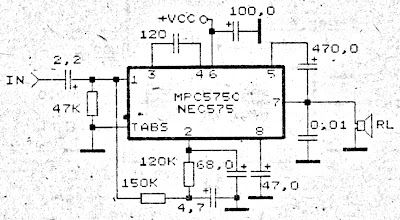
Amplifier circuit for small room

Amplifier circuit is very suitable to be used or applied in a narrow space such as in cars and so forth. Voltage amplifier is needed starting from 9 Volts to 17 Volts maximum. This amplifier circuit uses IC MPC575C, andsimilarities NEC575 . Power output is relatively very small, only 2 Watts.
Schematics Amplifier MPC575C
Read More..

Saturday, April 6, 2013

Compressor For Electret Microphone

The ‘FM Remote Control Receiver’ (available on this website in Infra-red circuits section) has a connector where an analogue output is made available. To make a simple intercom or P.A. system the associated transmitter needs a microphone pre-amplifier that outputs a signal at the correct level. And that is exactly the function of this circuit. Actually, this design is adapted from a circuit published last year (‘AM Modulator for Intercom’). A few things have been changed so that it can work with the 5 V supply from the transmitter module. The OTA (IC1) used here is the single version (CA3080), which has slightly different characteristics from the dual CA3280.

The quad opamp is the same rail-to-rail TS924IN, made by ST. The turnover frequency of the filter (3rd order 1 dB Chebyshev) has been increased slightly to improve the intelligibility of speech and is now about 5.5 kHz. The filter now amplifies the signal by a factor of 10. In practice it is possible that due to various tolerances and the fact that the opamp is not perfect, the filter characteristic shows some deviation from that required. In our prototype it was necessary to change R15 into 2k7 to straighten the response curve. The DC current variation at the output of the OTA and the resulting offset variation at the output of current/voltage converter IC2d is such that the gain of IC2d has to be substantially smaller than in the ‘old’ design.

Otherwise the output could easily rise to the supply voltage at low signal levels. The value of R6 has therefore been made smaller by a factor of 10. This has reduced the gain of the circuit by 20 dB, which is compensated for in the filter. The amplitude of the signal from IC2d is fed back as a control current to the OTA by peak rectifier D1/C3 and inverting amplifier IC2b. R7 limits the loading on IC2d. P1 can be used to adjust the amplifier between a fixed gain and maximum compression. Figure A shows clearly what effect the circuit has. 0 dBr corresponds to 100 mV. The maximum gain, with P1 set to maximum compression, is about 48 dB (250 Ω) for small signals.

The minimum gain is about 20 dB (10 Ω). The OTA is then slightly overdriven and the distortion becomes several percent! With a fixed gain selected (P1 shorted) the gain is about 42 dB (125 ×). The middle curve was measured with P1 in its central position. The curve drawn for a fixed gain (the straight line) doesn’t finish at the edge of the graph because the end of the line corresponds to the maximum possible output level, which is 25 dBr (≈1.76 V or 5 / 2√2). Figure B shows the frequency response. The low turnover frequency is mainly determined by C8 (and to a lesser extent by C1) and is about 120 Hz.

The current consumption is about 7 mA When the circuit is battery powered we recommend the use of three AA cells, because the circuit still works perfectly at 4.5 V. If you want to use a higher supply voltage (maximum 12 V for the de TS924IN and 30 V for the CA3080, but you should also think of the voltage across the electret microphone!) you have to keep in mind that the maximum current through R9 (which is IABC) is only 2 mA. When we consider a maximum chosen current of 1 mA and the maximum output voltage of IC2b (half the supply voltage, which is 2.5 V), then the value of R9 should be (2.5 – 0.7) V / 1 mA = 1.8 kΩ. The value of 0.7 V corresponds to the potential between pin 5 and earth.

For a larger safety margin R9 is calculated with the full supply voltage and a current of 2 mA: (5 – 0.7) V / 2 mA = 2k2 (rounded upwards). Of course the regulation will then be different (a little less gain). This circuit and the transmitter module can therefore be fed from the same 5 V supply. Because the transmitter requires a DC offset at its input, a resistor is connected to +5 V via a jumper, which biases the output to half the supply voltage. With the jumper open R17 functions as a load resistor when the output is not connected, because C9 still has to charge up even without a load. If you’re designing a PCB for this compressor then it makes sense to include the transmitter module as well. The current consumption then increases by about 10mA.
Read More..

Tuesday, April 2, 2013

SPI Interface Circuit for Big 7 Segment LED

This circuit is uses for the general purpose Big LED with SPI serial interfacing. The circuit is using a serial-in-parallel out shift register, 74HC595 for receiving serial data from microcontroller board. This is the figure of the circuit.


For wiring the schematic is SER is for data input, SRCLK is shift clock and RCLK is Latch clock. Each data bit is shifted into the register on rising edge of the shift clock. When all data bits are shifted into the 8-bit register, the rising edge of RCLK will clock the data to be latched at each output bit, i.e. QA - QH. The Big LED is made from cheap dot LED. Each segment has five dot LED connected in series with a limiting resistor tied to +12V. The logic high at the input of ULN2003 makes the output active low, thus sinks the LED current into the chip. The driver has 7-bit for segment a, b, c, d, e, f, and g. Q1 is for optional point display.

Multiple digits can easily be made by connecting the QH to the next digit serial input bit, see the circuit below. Please note that, the shift clock and latch signal are tied to every 74HC595.


Read More..