Showing posts with label led. Show all posts

Sunday, September 1, 2013

6W Four Channel LED Driver

CAT4106 is an integrated Four channel LED driver (multi-channel LED driver) and high power dc-dc converter suitable for powering backlighting applications up to a total of 6 watts. Up to four matched LED strings can be accurately programmed with uniform drive current set by a single external resistor. The CAT4106 Four channel LED driver automatically adjusts the output voltage to drive the highest forward voltage string with the minimum headroom voltage maximizing the efficiency.

6W Four Channel LED Driver Circuit diagram


High resolution dimming control is achieved by the EN/PWM logic pin which supports multiple frequencies. This ensures precise PWM dimming control while the device remains fully biased. In addition, when held at logic low, the device to enter a full shutdown zero current mode. External programming resistors set the minimum and maximum voltage limits for the acceptable window of operation for LED strings. Any channel which fails to regulate within the window (Open or Short LED) is detected and flagged on the FAULT logic output (active low, open-drain).

Main features of CAT4106 led driver are : four LED channels with tight current matching , integrated dc-dc boost converter , up to 6 W LED total output power , up to 92% efficiency , low dropout LED channels (500 mV at 175 mA) , high frequency PWM interface (up to 2 kHz) ,adjustable short/open LED detection The CAT4106 requires small ceramic capacitors of 1 μF on the VIN pin (C1), 4.7 μF on the inductor input (C2), and 10 μF on the output (C3). Under normal condition, a 4.7 μF input capacitor (C2) is sufficient. A 47 μH inductor is recommended with current rating of 1 A or higher and 1A rated Schottky diode .

A typical value for resistor R7 and R5 is around 20 kΩ. R6 and R4 can be calculated as follows:


Read More..

Friday, August 16, 2013

230V LED

Most of you asked about 230V LED circuit diagrams.Today Im going to introduce you that circuit.I have attached this circuit for my door bell.So that at night I can easily see it.Not only that people can us this circuit to see whether electricity is there or not So use thi9s circuit and get fun....


# Note

# you should be careful when you use this circuit.Because this circuit operates with 230V
# This circuit is not suitable for kids
# When you use electronic parts those parts should have correct values(like W and V)
# Build this circuit on a pcb If the circuit doesnt work dont touch it.Firstly switch off the circuit.
Read More..

Wednesday, July 31, 2013

LED Volt Meter Circuit

Here is a Simple LED Volt meter to Monitor the charge level in Lead Acid Battery or Tubular battery. The terminal voltage of the battery is indicated through a four level LED indicators. The nominal terminal voltage of a Lead Acid battery is 13.8 volts and that of a Tubular battery is 14.8 volts when fully charged. The LED voltmeter uses four Zener diodes to light the LEDs at the precise breakdown voltage of the Zener diodes. Usually the Zener diode requires 1.6 volts in excess than its prescribed value to reach the breakdown threshold level. When the battery holds 13.6 volts or more, all the Zener breakdown and all LEDs light up. When the battery is discharged below 10.6 volts, all the LEDs remain dark. So depending on the terminal voltage of the battery, LEDs light up one by one or turns off.
Circuit diagram:
LED-Volt-Meter-circuit-diagram12 LED Volt Meter Circuit Diagram
 
 
http://streampowers.blogspot.com/2012/06/led-volt-meter-circuit.html 
Read More..

Saturday, July 13, 2013

LED Matrix Horizontally

LEDs provide a befitting way to electronically display information. whereas the seven-segment LED brandish, organized in the pattern of the digit 8, is common, it does not permit the brandish of some alphanumeric individual features. A 5×7 commanded matrix permits the display of all ASCII individual features, as well as graphics shapes.

The circuit in this conceive concept displays an unconventional way to use a 5×7 LED matrix.You can use a conceive encompassing a set of 5×7 commanded flats without altering any thing in the circuitry, except for the arrangement of the commanded units. 


 Using one 5×7 LED matrix, or N units, horizontally instead of vertically allows the display of two characters, or 2×N characters. The minimum pattern for lowercase and uppercase letters requires only a 3×5 LED configuration, except for the letters M and m, which require at least a 5×5 LED configuration and need a dedicated subroutine.

The circuit in Figure 1 uses an 8-bit, 18-pin PIC micro controller and a decade counter to drive one or two 5×7 LED units to provide a display module of two or four digits. The circuit uses a small pushbutton switch to increment the counter. By default, the circuit works in high-brightness mode. If you press the pushbutton during power-on, the circuit works in low-power mode.
Read More..

Friday, July 5, 2013

Flashing LED Battery status Indicator

Signals when an on-circuit battery is exhausted 5V to 12V operating voltage
A Battery-status Indicator circuit can be useful, mainly to monitor portable Test-gear instruments and similar devices. LED D1 flashes to attire the users attention, signaling that the circuit is running, so it will not be left on by mistake. The circuit generates about two LED flashes per second, but the mean current drawing will be about 200µA. Transistors Q1 and Q2 are wired as an uncommon complementary astable multivibrator: both are off 99% of the time, saturating only when the LED illuminates, thus contributing to keep very low current consumption. 

Circuit diagram :
Flashing-LED Battery
Flashing-LED Battery-status Indicator Circuit Diagram

The circuit will work with battery supply voltages in the 5 - 12V range and the LED flashing can be stopped at the desired battery voltage (comprised in the 4.8 - 9V value) by adjusting Trimmer R4. This range can be modified by changing R3 and/or R4 value slightly.

When the battery voltage approaches the exhausting value, the LED flashing frequency will fall suddenly to alert the user. Obviously, when the battery voltage has fallen below this value, the LED will remain permanently off. To keep stable the exhausting voltage value, diode D1 was added to compensate Q1 Base-Emitter junction changes in temperature. The use of a Schottky-barrier device (e.g. BAT46, 1N5819 and the like) for D1 is mandatory: the circuit will not work if a common silicon diode like the 1N4148 is used in its place.

Parts :
R1,R7__________220R  1/4W Resistors
R2_____________120K  1/4W Resistor
R3_______________5K6 1/4W Resistor
R4_______________5K  1/2W Trimmer Cermet or Carbon
R5______________33K  1/4W Resistor
R6_____________680K  1/4W Resistor
R8_____________100K  1/4W Resistor
R9_____________180R  1/4W Resistor
C1,C2____________4µ7  25V Electrolytic Capacitors
D1____________BAT46  100V 150mA Schottky-barrier Diode
D2______________LED  Red 5mm.
Q1____________BC547   45V 100mA NPN Transistor
Q2____________BC557   45V 100mA PNP Transistor
B1_______________5V to 12V Battery supply
Notes :
  • Mean current drawing of the circuit can be reduced further on by raising R1, R7 and R9 values.


Streampowers
Read More..

Wednesday, June 12, 2013

LED Light Bulbs Save Energy on Mysore Palace Board


As the first step towards the conservation of energy, The Mysore Palace Board began working with the replacement of equipment outside the halls of the palace (along the tracks and walk to the door) with Eco-LED (light emitting diode of light). 12 volt led lights will be enough.

As part of the first stage of labor, 685 units were replaced with LED lights to a golden color, as desired by the Council of the palace.

The contract was awarded to a man named S. Mysore Nagaraj, CEO of green light Trishul, Bangalore.

Star of Mysore Nagaraj said the Rs 77 lakh contract for the replacement of more than 3,000 lights on the Palace Square, which will be implemented in five phases. "Each LED unit is guaranteed for 50,000 hours," said Nagaraj and added, "the unit cost of Rs 30 watts. 14 000 and 60 watt unit cost of Rs 28000th service and replacement guarantee has been issued for five years. "

Nagaraj said the LED lights with LED other contractors that submitted bids were reviewed by representatives of the Board of Directors of NIE engineers and technicians Palace before awarding the contract. They insisted on using a light outside the Palace of Golden Hue.

".. The main advantage of energy saving LED lamps produce more light on the production of electricity used for LED bulbs are a great power, consumes less electricity," said Nagaraj, adding LED lights have the stabilizer circuit voltage , which takes the voltage range of 90 to 270 volts. They are also recyclable, he said.

Related items:12 volt led light bulbs.12 volt led light bulb
Read More..

Tuesday, April 30, 2013

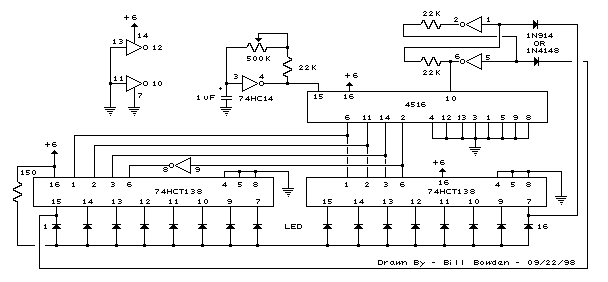
Build 16 Stage Bi Directional LED Sequencer

The bi-directional sequencer uses a 4 bit binary up/down counter (CD4516) and two "1 of 8 line decoders" (74HC138 or 74HCT138) to generate the popular "Night Rider" display. A Schmitt Trigger oscillator provides the clock signal for the counter and the rate can be adjusted with the 500K pot. Two additional Schmitt Trigger inverters are used as a SET/RESET latch to control the counting direction (up or down). Be sure to use the 74HC14 and not the 74HCT14, the 74HCT14 may not work due to the low TTL input trigger level. When the highest count is reached (1111) the low output at pin 7 sets the latch so that the UP/DOWN input to the counter goes low and causes the counter to begin decrementing.

 When the lowest count is reached (0000) the latch is reset (high) so that the counter will begin incrementing on the next rising clock edge. The three lowest counter bits (Q0, Q1, Q2) are connected to both decoders in parallel and the highest bit Q3 is used to select the appropriate decoder. The circuit can be used to drive 12 volt/25 watt lamps with the addition of two transistors per lamp as shown below in the section below titled "Interfacing 5 volt CMOS to 12 volt loads"

Circuit diagram

Read More..

Friday, April 12, 2013

LED Multicolour Backlights

This circuit comprises two parts: a string of 5mm high-intensity white LEDs connected in series and the circuit wired around. IC CD4060 with an inbuilt oscillator. The IC is wired such that its outputs Q4, Q5 and Q6 are chosen for colour display. On power-’on’ reset, these outputs go ‘high’ simultaneously but for different time durations. The Q4 output goes ‘high’ for about 18 seconds, Q5 about 38 seconds and Q6 about 80 seconds. These outputs are connected to forty 5mm LEDs through transistors T1, T2 and T3.

It is necessary to boost the current because LEDs are connected in parallel. To do so, transistor BD135 is used. The 1.2-kilo-ohm base resistor prevents overloading of BD135. The 100-ohm resistor acts as the current limiter. Provide heat-sink to each BD135 transistor. LEDs of three colours—blue, orange and red—are used here.
LED Multicolour Backlights
Fig. 1: Circuit for multicolour curtain backlight
To reduce the time duration for which IC outputs go high, replace 2.2-mega-ohm resistor (R4) with 1 mega-ohm. Replace 2.2-mega-ohm resistor with 3.9 mega-ohms to increase the time duration. Power supply for the IC is provided by 220V AC to 9V, 1.5A step-down transformer after rectification and filtering.

A combination of different colours results due to switching on of transistors T1 through T3 for different time durations. These colours with a white background create a beautiful display. The first group of LEDs lights up a few seconds after power to the circuit is switched ‘on.’

Fig. 2: Arrangement of LEDs
Read More..

Tuesday, April 2, 2013

SPI Interface Circuit for Big 7 Segment LED

This circuit is uses for the general purpose Big LED with SPI serial interfacing. The circuit is using a serial-in-parallel out shift register, 74HC595 for receiving serial data from microcontroller board. This is the figure of the circuit.


For wiring the schematic is SER is for data input, SRCLK is shift clock and RCLK is Latch clock. Each data bit is shifted into the register on rising edge of the shift clock. When all data bits are shifted into the 8-bit register, the rising edge of RCLK will clock the data to be latched at each output bit, i.e. QA - QH. The Big LED is made from cheap dot LED. Each segment has five dot LED connected in series with a limiting resistor tied to +12V. The logic high at the input of ULN2003 makes the output active low, thus sinks the LED current into the chip. The driver has 7-bit for segment a, b, c, d, e, f, and g. Q1 is for optional point display.

Multiple digits can easily be made by connecting the QH to the next digit serial input bit, see the circuit below. Please note that, the shift clock and latch signal are tied to every 74HC595.


Read More..