Showing posts with label . Show all posts

Tuesday, July 30, 2013

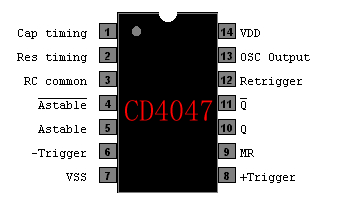
12VDC – 220VAC Inverter Using Cmos CD4047

12VDC – 220VAC Inverter Using Cmos CD4047
This circuit inverter converts 12V DC battery to AC 22oV as the replacement of home energy. The inverter can be used for small electronic devices such as lamps, radio, phone charger, disc player, etc.
12VDC – 220VAC Inverter Using Cmos CD4047
The inverter circuit is a central component, the CMOS 4047, and converts a DC voltage of 12 V to 220 V AC voltage. 4047 is used as an astable multivibrator. The pin 10 and 11 we find a symmetrical rectangular signal is amplified by Darlington transistors T1 and T2 trailer, and finally reaches the secondary coil of a transformer of the network (2 x 10V/100VA). Primary coil voltage is 220 AC voltage terminals. For best performance, use a toroidal core transformer with low losses. P1 to the output frequency can be regulated within certain limits (50 ... 400 Hz).
Read More..

Thursday, July 4, 2013

LM1875 – POWER AMPLIFIER 20 WATT

 
The LM1875 is a monolithic power amplifier offering very low distortion and high quality performance for consumer audio applications.

The LM1875 delivers 20 watts into a 4Ω or 8Ω load on ±25V supplies. Using an 8 load and ±30V supplies, over 30 watts of power may be delivered. The amplifier is designed to operate with a minimum of external components. Device overload protection consists of both internal current limit and thermal shutdown.

The LM1875 design takes advantage of advanced circuit techniques and processing to achieve extremely low distortion levels even at high output power levels. Other outstanding features include high gain, fast slew rate and a wide power bandwidth, large output voltage swing, high current capability, and a very wide supply range. The amplifier is internally compensated and stable for gains of 10 or greater.

Features
• Up to 30 watts output power
• AVO typically 90 dB
• Low distortion: 0.015%, 1 kHz, 20 W
• Wide power bandwidth: 70 kHz
• Protection for AC and DC short circuits to ground
• Thermal protection with parole circuit
• High current capability: 4A
• Wide supply range 16V-60V
• Internal output protection diodes
• 94 dB ripple rejection
• Plastic power package TO-220
LM1875 - POWER AMPLIFIER 20 WATT, link
Read More..

Sunday, May 26, 2013

Power Circuit Breaker – Operation and Control Scheme

Power Circuit Breakers (PCB) break an electrical circuit to isolate faults. They also re-close to make a circuit after the fault is removed. To enable this opening and closing, it is operated by either a remote relay or a local switch. A remote relay is located inside the control room while the switch is located inside the circuit breaker junction box.Close and Trip Circuit of a Breaker


Understanding a breaker scheme is important if you plan on designing a substation. Quite often, it is overwhelming to make sense of the entire scheme at a glance. The figure below depicting a circuit breaker scheme will be used to explain various elements of the PCB’s design and its control.

Forms of Contact
Before explaining what each device in the scheme does, understanding the different forms of contact is necessary. A form ‘a‘ contact represents a Normally Open (N.O.) contact while a form ‘b‘ is a Normally Closed (N.C.) contact. Thus when a breaker is de-energized, its 52a and 52b contact position stay true to the statement above and as shown in Figure 1. However, when PCB is energized, the contacts switch their state i.e. 52a contact will be closed while 52b is open. Contact positions of all other auxiliary relays and switches – remote or local – stay unchanged unless, ofcourse, they operate on a fault or other desired condition.

Circuit Breaker Trip Coil
Figure above depicts a trip coil of the breaker. For brevity, I will cover the trip coil no.1 with trip coil no.2 identical.
From the diagram, the breaker is fitted with a 43 switch that toggles between local trip and remote trip. Positioning it in local allows the persons at the breaker junction box to trip the circuit by closing the Control Switch (CS). Switching it to remote position permits the relays in the control house to close their contact and trip the breaker.
Modern PCB’s employing Sulfur Hexa-Flouride (SF6) gas to extinguish an arc are fitted with ANSI ’63′ relay. To prevent breaker damage due to flash-overs during low gas conditions, tripping of breaker is cut-out by this relay’s contact. Notice in Figure 1 how the contacts from this relay are strategically placed in the close and trip circuit to cut out any signal from the relays or switches.
At this point, the reader should realize the importance of contact development. All contacts operate only when the trip coil of their respective relay is energized. For instance, consider the 63 relay and its contacts shown in in figure 1. This relay is energized by the same DC source as the one supplying the breaker. However its trip coil is actuated by a transducer that can sense a fall in SF6 gas pressure. When this occurs, it switches its contacts located in different circuits to prevent any breaker operation. Similarly, the 27 undervoltage relay trip coil is connected across the DC source. When this supply is interrupted, the relay switches its contact position. This change can be relayed to an alarm or initiate some other action.
To trip the breaker from a remote location, all contacts from relays at the remote location shall be hard-wired. Yes, this means laying a lot of copper from the breaker cabinet to the relays. Further, all tripping contacts are wired in parallel. When either relay’s contact close and thus complete the circuit, the breaker trips.

Target Devices
Now, you may notice the red target lamp is connected in a way that will essentially short out the remote relays and trip the breaker. Not surprisingly, this is not the case. The target lamps shown in the scheme have enough resistance in them (~200 ohms), limiting the current that can energize the coil.
Target lamps are used in circuits to convey certain conditions. With the breaker closed and energized, the red lamp illuminates to indicate a live circuit. When the breaker opens (due to a fault) the green lamp illuminates – the circuit complete with 52b contact switching from open to close.
Most modern circuit breakers are specified with two trip coils. Energizing either one leads to breaker’s trip. Since a good amount of redundancy is built into the protection and control of a power system, it is not too uncommon to see all primary relaying in the system tripping trip coil 1 and the back-up tripping trip coil 2.

Circuit Breaker Close Coil
This coil when energized actuates a lever that engages the closing mechanism (like a spring). A close circuit is optionally fitted with both 43 local/remote switch and a local trip switch. Remote relays are wired in as shown in Figure 1. Unlike the trip circuit, the relay contacts in the close circuit are always connected in series and present in normally closed position. Thus, when a relay trips, it also blocks closing of the breaker. Until the relay is reset, either manually or remotely, the breaker will not be operational.

Anti-Pump Relays
To prevent inadvertent multiple closing operation, breakers are fitted with anti-pump relay. Assume a scenario where a fault persists on a line and a person is looking to close a breaker on it. Although the person presses the close button for a second or two, for the breaker which operates in cycles, this duration is an eternity. With the close button pressed, the breaker attempts to close but because of the fault in the system it trips again, then closes, then trips. This trip/close operation repeats for the second or two the button is pressed. Since the motor in the breaker is not rated for continuous duty, serious damage can occur to it.

Modern breaker control relays are programmed to check for synchronism and also to reclose a breaker. A single contact from this relay is all that is needed to initiate one-shot, two-shot, or three-shot scheme. In old breaker schemes, 25 relay contacts and reclosing relay (79) contacts are typically wired into the breaker close scheme.

On a final note, keep in mind that not all relays can handle the momentary trip/close coil currents. Auxiliary relays like an electro-switches are typically employed to handle these currents.
Read More..

Tuesday, May 14, 2013

Tunisian Italian cooperation – Connecting electrical networks

Electricity_towers_tunisia_italy


Tunisia and Italy have signed a project to connect the electrical networks according to the framework of the interconnection between the energy networks of the Maghreb and Europe.
The realisation of the project, which has been entrusted on the Tunisian part to the Tunisian Electricity and Gas Company (STEG), and on the Italian part to Italy’s electricity transportation company, is estimated at some 4 billion dinars.

It involves the construction of an electric power plant with a capacity of 1200MW, including 400MW, destined to cover Tunisia’s electricity needs, as well as a submarine interconnection between both countries of some 200 km, with a capacity of 1000MW.

The submarine interconnection is part of a Mediterranean project aiming at the creation of an integrated platform for the international exchange of electricity with neighboring southern Mediterranean countries, as well as with European countries via Italy.

Italy is Tunisia’s second trade partner with a volume of exchanges amounting to 10 billion dinars in 2008. Italy is also Tunisia’s 3 rd provider of foreign direct investments (FDI’s) as well as in the number of tourists which visit the country.

The economic/trade relations are intense, Italy ranks as Tunisia’s second trade partner, while Tunisia is one of the top markets for Italian exports in the Mediterranean, second only to Turkey.

Total trade in 2007 reached approximately 5.4 billion euro, with a positive trade balance in Italy’s favour of 463 million euro.

Our main exports are refined petroleum products (13.4% of the total), textiles (10.6%) and various types of machinery (5.5%). Imports from Tunisia are mainly in the sectors of clothing textiles (16.7% of the total), oils and animal and vegetable fats (11.2%) and hydrocarbons (6.9%).

There are approximately 700 sole-ownership or joint Italian businesses operating in Tunisia that employ nearly 50,000 persons, for an investment total of around 103 million euro. Italian investments are mainly in the sectors of chemicals and rubber, electricity and electronics, construction, transport, tourism, mechanics and metallurgy, food and agriculture, and leather and shoes.

Many Italian firms have also been awarded major Tunisian infrastructure contracts. Additional attractive opportunities are also expected for Italian firms following the Tunisian government’s approval of the 11th 5-year development plan (2007-2011) that calls for major investments in public works.

Despite this already solid economic partnership, Italy still feels the need to strengthen its business presence and participation in the infrastructure projects being planned by Tunisia over the coming years in various sectors, such as sea transport and seaport services, energy and tourism.

The energy sector is one of the most important areas of economic collaboration between Italy and Tunisia. Within the framework of plans to integrate the European and Maghreb electrical power systems a joint Italo-Tunisian project is being studied that envisions the construction of a combined-cycle electrical power plant at El Houaria and an underwater electrical power cable connection with Italy. The Italian firm Terna is working with the Tunisian firm STEG on designing a project for the  construction and management of that power plant. Other initiatives for potential collaboration in the field of energy could include the creation of other electrical power plants (Gannouche, Korba, Bir Mcherga, Ajloula).

The Italian firm ENI is particularly important in the hydrocarbons sector and manages the Transmed gas pipeline collecting Algeria with Sicily through Tunisia, which is currently being enlarged by the SNAM. The capacity of this pipeline is slated for boostong by the end of 2008 to an annual total of approximately 34 billion cubic metres.

Italy is also likely to find some appealing building prospects in the foreseen integration of the Euro-Mediterranean  agriculture/food processing sector, with the possibility of making Italy one of the privileged access routes for high-quality Tunisian products directed into Europe. Indeed, Italy is favoured by its geographical proximity and the high quality of its food processing and packaging industries.

There are also good prospects for collaboration in the context of organic agriculture, for which Tunisia is the only country in the Middle East and North African region to have approved a specific development strategy and ad hoc regulations.

Finally, there are major prospects for the development of the tourism sector, where Italy is already substantially active. In January 2006 a bilateral cooperation agreement was signed with the objective of creating a legal and regulatory context allowing for increased public and private cooperation between the two countries and increases in the already significant flow of tourists between Italy and Tunisia.
Read More..