Spy Camera Solar Power Box Circuit diagram :
Wednesday, December 25, 2013
Spy Camera Solar Power Box
Spy Camera Solar Power Box Circuit diagram :
Switch Selected Fixed Voltage Power Supply Circuit Diagram

Wednesday, December 18, 2013
High Power Car Battary Eliminator
Best Power Protection Circuit Diagram

Tuesday, December 17, 2013
How to Build a Simple Power supply Circuit Diagram

Tuesday, September 3, 2013
500W Mos Fet Power Inverter from 12V to 110V 220V
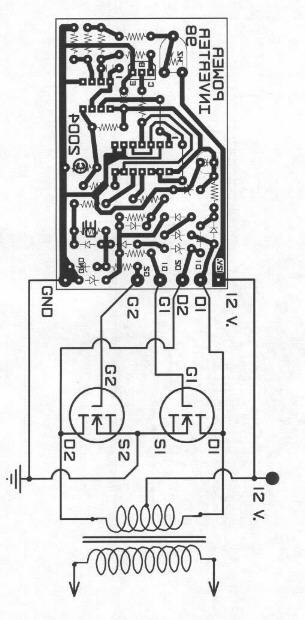
This circuit will provide a very stable "Square Wave" Output Voltage. Frequency of operation is determined by a pot and is normally set to 60 Hz. Various "off the shelf" transformers can be used. Or Custom wind your own FOR BEST RESULTS. Additional MosFets can be paralleled for higher power. It is recommended to Have a "Fuse" in the Power Line and to always have a "Load connected", while power is being applied. The Fuse should be rated at 32 volts and should be approximately 10 Amps per 100 watts of output. The Power leads must be heavy enough wire to handle this High Current Draw!
Appropriate Heat Sinks Should be used on the RFP50N06 Fets. These Fets are rated at 50 Amps and 60 Volts. ** Other types of Mosfets can be substituted if you wish. The LT1013 offers better drive that the LM358, but its your choice. The Power transformer must be capable of handling the chosen wattage output. Also, Appropriate Heat Sinks are Necessary on the Mos-Fets. Using a rebuilt Microwave transformer as shown below, it should handle about 500 watts Maximum. It requires about 18 turn Center-Tapped on the primary. To handle 500 watts would require using a 5 AWG wire. Pretty Heavy Stuff, but so is the current draw at that power.
Monday, September 2, 2013
Power Resumption Alarm and Low Voltage Protector
unregulated power supply is derived from a 12V-0-12V, 300mA step-down transformer and rectifying diodes D2 and D3. The rectified DC is made ripple-free using capacitor C3. An audio/video indicator (piezobuzzer and LED3) is provided along with the power supply for power resumption.
When power is switched on, capacitor C4 charges through the piezobuzzer and LED3, making both of them active. The piezobuzzer beeps and LED3 glows for a few seconds. When capacitor C4 is fully charged, the cathode of the LED becomes high inhibiting further flow of current through the buzzer.
When the power is off, capacitor C4 discharges through resistor R9.
The circuit uses IC CA3140 (IC1) as a voltage comparator to detect voltage changes in the unregulated power supply due to AC mains. Mains voltage changes in the primary as also the secondary winding of the transformer, which is sensed by IC1 to energise/de-energise the relay. Zener diode ZD1 provides a reference voltage of 3V to make transistor T1 conduct. Preset VR1 adjusts the breakdown point of ZD1.
Fig. 1: Power supply circuit with resume indicator
When the voltage level is normal, zener diode ZD1 breaks down and transistor T1 is forward-biased. Capacitor C1 provides time delay of a few seconds to avoid any fluctuation affecting the device during power-on. When transistor T1 conducts, the inverting input (pin 2) of IC1 goes low. However, IC1 does not give a high output as its power supply depends on the conduction of SCR1 (BT169). So manual operation is necessary to energise the relay.
When push-to-on swish S1 is pressed, SCR1 fires to provide voltage to IC1 at its pin 7. As the voltage level at the non-inverting input (pin 3) of IC1 is half of the supply voltage, its output becomes high and the relay (RL1) energises. LED2 glows to indicate the high output of IC1 and activation of relay.
When the line voltage goes below 180V, the secondary voltage of the transformer also drops, say, below 12 volts, ZD1 cease to conduct and the collector of T1 becomes high. This high voltage at the inverting input (pin 2) of IC1 makes its output low. The relay de-energises to stop power to the device.
Fig. 2: Low-voltage Protector Circuit Diagram
Assemble the circuit on a general-purpose PCB and enclose in a suitable cabinet. Use a 12V PCB-mounted relay. Provide holes for LEDs and switch S1 on the front side of the case. Connect AC power voltage to the motor (load) through the common and normally-open (N/O) contacts of the relay. After assembly and checking the circuit, switch on the circuit and wait for a few minutes. LED1 will gradually become bright due to the charging of capacitor C1. Press S1 to energise the relay. Adjust VR1 so as to make LED1 fully on. This will allow easy latching of the relay.
Saturday, August 31, 2013
High Power Alarm Driver
High-Power Alarm Driver Circuit Diagram
Wednesday, August 14, 2013
100Khz Multiple Output Switching Power Supply Circuit Diagram

Constructing your own Dual Power Supply Rise
Note that the + & - regulators do not must be matched: you can for example, use a +5v & -9V pair. However,the positive regulator must be a 78xx regulator, & the negative a 79xx. They have built in plenty of safety in to this project so it ought to give plenty of years of continuous service.
This Dual Power Supply design makes use of a full wave bridge rectifier coupled with a centre-tapped transformer. A transformer with a power output rated at at least 7VA ought to be used. The 7VA rating means that the maximum current which can be delivered without overheating will be around 390mA for the 9V+9V tap; 290mA for the 12V+12V and 230mA for the 15V+15V. If the transformer is rated by output RMS-current then the worth ought to be divided by one.2 to get the current which can be supplied. For example, in this case a 1A RMS can deliver 1/(one.2) or 830mA.
The purpose of the filter capacitor is to smooth out the ripple in the rectified AC voltage. Theres dual amount of ripple is determined by the worth of the filer capacitor: the larger the worth the smaller the ripple.The two,200uF is an appropriate value for all the voltages generated using this project. The other consideration in choosing the correct capacitor is its voltage rating. The working voltage of the capacitor has to be greater than the peak output voltage of the rectifier. For an 18V supply the peak output voltage is one.4 x 18V, or 25V. So they have selected a 35V rated capacitor.
Monday, August 12, 2013
TBA820 low power audio amplifier


C3 = 470uF
C4 = 220pF
Sunday, August 11, 2013
100 Watt Power Amplifier Circuit With IC TDA7294
The power supply circuit. Positive, negative, and ground. Usually, we use the power supply circuit to + /-25V to + /-35V at 100W RMS will be used to heat sufficiently.
After many members have already made the TDA7294 as I know, with a sound quality that is the very gods or Hi-End itself.

Achieved by increasing the voltage raising circuit For the more, it means high power and high heat up. Today I have come across. I use IC TDA7294 circuit at the time.
In-Home Use amplifier circuit is a Class G amplifier with low power consumption, resulting in the loss of a 20V DC power less.
And when you’re driving a high-power random access is party to a rhythm. Principles to do it. I took out a membership you can do is try to build up a bit.
We provides PCB both top and bottom side for you.
Saturday, August 10, 2013
Simple 0 30 Volts 2 5A Variable Power Supply Circuit Diagram
0-30 Volts - 2-5A Variable Power Supply Circuit Diagram

Wednesday, August 7, 2013
0 30 Volt Power Supply


Tuesday, August 6, 2013
High Voltage 3 Watt Audio Power Amplifier Circuit
The LM4954 is an audio power amplifier primarily designed for demanding applications in mobile phones and other portable communication device applications. It is capable of delivering 2.4 Watts of continuous average power to an 8 BTL load with less than 1% THD+N from a 7VDC power supply.
Boomer audio power amplifiers are designed specifically to provide high quality output power with a minimal number of external components. The LM4954 does not require output coupling capacitors or bootstrap capacitors, and therefore is ideally suited for lower-power portable applications where minimal space and power consumption are primary requirements.
Circuit Diagram:
High Voltage 3 Watt Audio Power Amplifier Circuit Diagram
The LM4954 features a low-power consumption global shutdown mode which is achieved by driving the shutdown pin with logic low. Additionally, the LM4954 features an internal thermal shutdown protection mechanism.
The LM4954 contains advanced pop & click circuitry which eliminates noises that would otherwise occur during turn-on and turn-off transitions.
The LM4954 is unity-gain stable and can be configured by external gain-setting resistors.
Key Specification:
| Wide Power Supply Voltage Range | 2.7 <= VDD <= 9V |
| Output Power: VDD = 7V, 1% THD+N | 2.4W (typ) |
| Quiescent power supply current | 3mA (typ) |
| PSRR: VDD = 5V and 3V at 217Hz | 80dB (typ) |
| Shutdown power supply current | 0.01µA (typ) |
Features:
Applications
Source:national
Stereo Power Amplifier Circuit based on BA5417
Note :
- Supply voltage range of BA5417 is from 6 to 15V DC.
- The recommended supply voltage for this circuit is 12V DC.
- The power supply must be well regulated and filtered.
- BA5417 requires a heatsink.
- The circuit can be assembled on a perf board without much degradation in performance.
Monday, August 5, 2013
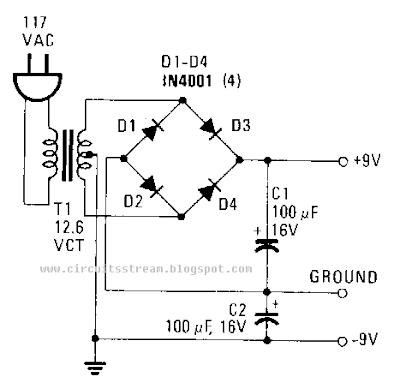
Simple split power supply circuit Diagram

Saturday, August 3, 2013
Panasonic Microwave Oven Inverter HV Power Supply
the front.
The High Voltage Power Supply Unit (HV PSU)


1. Apart from the block diagram, there is no information on the Inverter cont(o)rol circuit. The circuit itself is centred on one large, unmarked IC, so no help there.
2. The control and status signals seem to be a digital stream (2-3v suggestsa 5V data stream). They are opto-isolated because the majority of the circuit is at mains potential (**BEWARE**). The part that isn’t is at 4kV (*** REALLY BEWARE ***)
3. The mains input side is monitored for both current and (under) voltage. No indication of what the control circuit does with this information.
4. The mains filter capacitor (C702) is very small – only 4uF. In a “normal” switching supply, there is usually 220 or 470 uF in this position.
5. Q701 that does all the hard work is a very heavy duty IGBT – a GT60N90 - 900V @ 60 A. Q702 forms some sort of flywheel circuit. This circuit from a Toshiba IGBT application note looks similar:

7. The HV filter capacitors are only 8200 pF each, effectively giving 4100pF in the doubler. Considering that the inverter runs at about 30kHz, the reactance is equivalent to that of a 5uF capacitor at 50Hz.
8. The positive side of the HV is grounded, so it’s a –4kV supply. Don’t simply swap the ground from the positive to the negative to get a +4kV supply, as the core of the transformer is also connected to this ground trace and will suddenly rise to 4kV above ground with disastrous and potentially fatal results. Instead, reverse the polarity of the rectifier diodes to get +4kV.
Build a 0 To 12V 1A Variable Power Supply Circuit Diagram
Pin 1 of the LM317T is the adjustment pin. Varying the voltage on pin 1 (via PI) varies the output voltage. Diodes D5 through D7 and LEDs LI through L3 give an approximate indication of the output voltage. Each LED/diode path has a limiting resistor to limit the current to a level that is safe for the LED.

Saturday, July 13, 2013
Power On Indicator