Showing posts with label ic. Show all posts

Saturday, December 21, 2013

Simple IC LM35 Temperature Sensor Characteristics

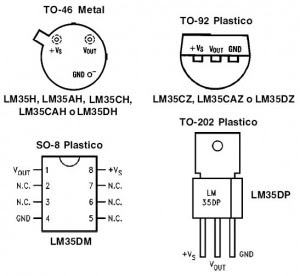
LM 35 temperature sensor IC is a IC chip production Natioanal Semiconductor which serves to determine the temperature of an object or space in the form of electric scale, or can also be defined as an electronic component that is used to change the temperature changes are accepted in the electrical wholesale changes. LM35 temperature sensor IC temperature change can change a change in voltage at the output. LM35 temperature sensor IC requires +5 volts DC source voltage and DC current consumption of 60 mA in operation. Physical form LM 35 temperature sensor is an IC chip with packaging that varies, in general packaging LM35 temperature sensor is packaged TO-92 as shown in the figure below.


Simple IC LM35 Temperature Sensor Characteristics


From the picture above it can be seen that the temperature sensor IC LM35 basically have 3 pin that serves as a source of supply voltage of +5 volts DC, as a result of sensing the output pin in the form of a change in the DC voltage and Vout pin to Ground.

IC LM35 temperature sensor characteristics are:

  •     Temperature sensitivity, with linear scaling factor between voltage and temperature 10 mVolt / º C, so it can be calibrated directly in centigrade.
  •     Have the accuracy or the accuracy of the calibration is 0.5 º C at 25 º C.
  •     Has a maximum operating temperature range between -55 º C to +150 º C. Working at a voltage of 4 to 30 volts.
  •     Has current low at less than 60 mA.
  •     Have a low self-heating (low-heating) of less than 0.1 º C in still air.
  •     Has a low output impedance is 0.1 W for 1 mA load.
  •     have Nonlinearities only about ± ¼ º C.

Read More..

Friday, December 20, 2013

Shortwave SW Transmitter Based IC BEL1895


Here the SW transmitter circuit based on IC BEL1895. This particular transmitter circuit works in shortwave HF band (6 MHz to 15 MHz), and can be applied for shortrange communication and for educational purposes.

Shortwave (SW) Transmitter Circuit diagram :


The circuit is composed of a mic amplifier circuit, a variable frequency oscillator, and modulation amplifier stages. Transistor T1 (BF195) is put to use as a simple RF oscillator. Resistors R6 and R7 determine base bias, while resistor R9 is utilized for stability. Feedback is provided by 150pF capacitor C11 to maintain oscillations. The primary of shortwave oscillator coil and variable condenser VC1 (365pF, 1/2J gang) form the frequency determining network.

By altering the coil inductance or the capacitance of gang condenser, the frequency of oscillation can be modified. The carrier RF signal from the oscillator is inductively coupled through the secondary of transformer X1 to the next RF amplifier-cum-modulation stage assembled around transistor T2 that is run in class ‘A’ mode. Audio signal from the audio amplifier assembled around IC BEL1895 is coupled to the emitter of transistor 2N2222 (T2) for RF modulation.

IC BEL1895 is a monolithic audio power amplifier intendeded for sensitive AM radio applications. It can deliver 1W power to 4 ohms at 9V power supply, with low distortion and noise characteristics. Since the amplifier’s voltage gain is of the order of 600, the signal from condenser mic can be straightly linked to its input without any amplification.

The transmitter’s stability is managed by the quality of the tuned circuit parts as well as the degree of regulation of the supply voltage. A 9V regulated power source is required. RF output to the aerial consists of harmonics, because transistor T2 doesn’t have tuned coil in its collector circuit. However, for short-range communication, it does not create any trouble. The harmonic content of the output may be lowered by means of a high-Q L-C filter or resonant L-C traps tuned to each of the prominent harmonics. The power output of this transmitter is about 100 milliwatts.
Read More..

Sunday, August 11, 2013

100 Watt Power Amplifier Circuit With IC TDA7294

Power Amplifier TDA7294 is a power amplifier with IC Power Amplifier is a mono 100W Class AB operation of OCL.

The power supply circuit. Positive, negative, and ground. Usually, we use the power supply circuit to + /-25V to + /-35V at 100W RMS will be used to heat sufficiently.

After many members have already made the TDA7294 as I know, with a sound quality that is the very gods or Hi-End itself.


Several days before the member’s PM to me saying that I had an amplifier using IC TDA7294 to have more of the same. Higher power. And low heat.

Achieved by increasing the voltage raising circuit For the more, it means high power and high heat up. Today I have come across. I use IC TDA7294 circuit at the time.

In-Home Use amplifier circuit is a Class G amplifier with low power consumption, resulting in the loss of a 20V DC power less.

And when you’re driving a high-power random access is party to a rhythm. Principles to do it. I took out a membership you can do is try to build up a bit.

We provides PCB both top and bottom side for you.
Read More..

Friday, April 12, 2013

Shortwave SW Transmitter Based IC BEL1895


Here the SW transmitter circuit based on IC BEL1895. This particular transmitter circuit works in shortwave HF band (6 MHz to 15 MHz), and can be applied for shortrange communication and for educational purposes.

Shortwave (SW) Transmitter Circuit diagram :


The circuit is composed of a mic amplifier circuit, a variable frequency oscillator, and modulation amplifier stages. Transistor T1 (BF195) is put to use as a simple RF oscillator. Resistors R6 and R7 determine base bias, while resistor R9 is utilized for stability. Feedback is provided by 150pF capacitor C11 to maintain oscillations. The primary of shortwave oscillator coil and variable condenser VC1 (365pF, 1/2J gang) form the frequency determining network.

By altering the coil inductance or the capacitance of gang condenser, the frequency of oscillation can be modified. The carrier RF signal from the oscillator is inductively coupled through the secondary of transformer X1 to the next RF amplifier-cum-modulation stage assembled around transistor T2 that is run in class ‘A’ mode. Audio signal from the audio amplifier assembled around IC BEL1895 is coupled to the emitter of transistor 2N2222 (T2) for RF modulation.

IC BEL1895 is a monolithic audio power amplifier intendeded for sensitive AM radio applications. It can deliver 1W power to 4 ohms at 9V power supply, with low distortion and noise characteristics. Since the amplifier’s voltage gain is of the order of 600, the signal from condenser mic can be straightly linked to its input without any amplification.

The transmitter’s stability is managed by the quality of the tuned circuit parts as well as the degree of regulation of the supply voltage. A 9V regulated power source is required. RF output to the aerial consists of harmonics, because transistor T2 doesn’t have tuned coil in its collector circuit. However, for short-range communication, it does not create any trouble. The harmonic content of the output may be lowered by means of a high-Q L-C filter or resonant L-C traps tuned to each of the prominent harmonics. The power output of this transmitter is about 100 milliwatts.
Read More..

Wednesday, April 10, 2013

Understanding SG3525 IC Pin Outs

The article explains the pin out functions of the IC SG3525 which is a regulating pulse width modulator IC. Lets understand in details:


The main features of the IC SG3525 may be understood with the following points:


  • Operating voltage = 8 to 35V
  • Error amp reference voltage internally regulated to 5.1V 
  • Oscillator frequency is variable through an external resistor within the range of 100Hz to 500 kHz.
  • Facilitates a separate oscillator sync pin out.
  • Dead time control is also variable as per intended specs.
  • Has an internal soft start feature
  • Shut down facility features a pulse by pulse shutdown enhancement.
  • Input under voltage shut down feature also is included.
  • PWM pulses are controlled through latching for inhibiting multiple pulse outputs or generation.
  • Output supports a dual totem pole driver configuration.


SG3525 Pin-Out Description

A practical implementation of the following pin-out data may be understood through this inverter circuit

The IC SG3525 is a single package multi function PWM generator IC, the main operations of the respective pin outs are explained with the following points:

Pin#1 and #2 (EA inputs): These are inputs of the built-in error amplifier of the IC. Pin#1 is the inverting input while pin#2 is the complementary non-inverting input.
Its a simple opamp arrangement inside the IC whose output controls the PWM of the output. Thus these pin outs can be effectively used for correcting the output voltage of a converter.

It may be done by applying a sample voltage from the output through a voltage divider network to the non-inverting input of the opamp (pin#1). The fed voltage should be adjusted to be just below the internal reference voltage value when the output is normal.....now if the output voltage increases, the sample voltage would also increase and at some point exceed the reference limit, prompting the IC to take necessary corrective measures so that the voltage is restricted to the normal level.

Pin#3 (Sync): This pin can be used for synchronizing the IC with an external oscillator frequency. This is generally done when more than a single IC is used and requires to be controlled with a common oscillator frequency.

Pin#4 (Osc. Out): Its the oscillator output of the IC, the frequency of the IC may be confirmed at this pin out.

Pin#5 and #6(Ct, Rt): These are termed Ct, Rt respectively. Basically these pin outs are connected with external resistors and capacitors for setting up the frequency of the inbuilt oscillator stage or circuit. Ct must be attached with a relevant capacitor while the Rt pin with a resistor for optimizing the frequency of the IC.

Pin#7 (discharge): This pin out can be used for determining the dead time of the IC, meaning the time gap between the switching of the two outputs of the IC (A and B). A resistor connected across this pin and ground fixes the dead time of the IC.

Pin#8 (Soft Start): This pin out as the name suggests is used for initiating the operations of the IC in a soft manner instead of a sudden or abrupt jerk. The capacitor connected across this pin and ground decides the level of soft initialization of the output of the IC.

Pin#9 (Comp): This pin out is not so important, just needs to be connected with the INV input of the error amplifier in order to keep the EA operations smooth and without hiccups.

Pin#10 (Shutdown): As the name suggest this pin out may be used for shutting down the outputs of the IC in an event of a circuit malfunction or some drastic conditions. A logic high at this pin out will instantly narrow down te PWM pulses to the maximum possible level making the output devices current go down to minimal levels. However if the logic high persists for longer period of time, the IC prompts the slow start capacitor to discharge, initiating a slow turn ON and release. This pin out should not be kept unconnected for avoiding stray signal pick ups.

Pin#11 and #14 (output A and output B): These are the two outputs of the IC which operate in a  totem pole configuration or simply in a flip flop or push pull manner. External devices which are intended for controlling the converter transformers are integrated with these pin outs for implementing the final operations.

Pin#12 (ground): Its the ground pin of the IV or the Vss.

Pin#13(Vc): The output to A and B are switched via the supply applied to pin#13. This is normally done via a resistor connected to the main DC supply. Thus this resistor decides the magnitude of trigger current to the output devices.

Pin#15 (Vi): Its the Vcc of the IC, that is the supply input pin.

Pin#16: It provides the internal 5.1V reference for optional use. This pint must be terminated with a low value capacitor to ground.


Read More..