Showing posts with label with. Show all posts

Sunday, August 11, 2013

100 Watt Power Amplifier Circuit With IC TDA7294

Power Amplifier TDA7294 is a power amplifier with IC Power Amplifier is a mono 100W Class AB operation of OCL.

The power supply circuit. Positive, negative, and ground. Usually, we use the power supply circuit to + /-25V to + /-35V at 100W RMS will be used to heat sufficiently.

After many members have already made the TDA7294 as I know, with a sound quality that is the very gods or Hi-End itself.


Several days before the member’s PM to me saying that I had an amplifier using IC TDA7294 to have more of the same. Higher power. And low heat.

Achieved by increasing the voltage raising circuit For the more, it means high power and high heat up. Today I have come across. I use IC TDA7294 circuit at the time.

In-Home Use amplifier circuit is a Class G amplifier with low power consumption, resulting in the loss of a 20V DC power less.

And when you’re driving a high-power random access is party to a rhythm. Principles to do it. I took out a membership you can do is try to build up a bit.

We provides PCB both top and bottom side for you.
Read More..

Wednesday, August 7, 2013

How to Build Toxic Gas Detector and Alarm Circuit with TGS813

The danger always exists, when the fuel gases such as propane or gas are confined to a small area. The alarm of toxic gases figs. 1-45 utilizes a tin-oxide-semiconductor. A coil of thin wire heated by a battery 12 V via IC1 and IC2, which pulses the voltage to the coil of the sensor, saving a significant amount of energy. Diode Zener Dl provides a constant voltage to the filament coil sensor. resistance of the sensor reduces the sensor is exposed to toxic gases such as hydrogen, carbon

Carbon monoxide and propane. To reduce the resistance of the sensor, the SCR gate voltage increases. When the gate threshold voltage is reached, the SCR fires and a buzzer alarm is activated. Once activated, the bell and the switch S1 should be used to reset the alarm. Since the sensor has a good deal of thermal inertia, S1 must be off or open for about three or four minutes after the initial activation, allowing the sensor to stabilize, thus avoiding false alarms. R7 sensitivity control set to the desired value, before the activation of SCR.

How to Build Toxic Gas Detector and Alarm Circuit with TGS813

The toxic gas alarm is sensitive to less than 100 ppm of carbon monoxide. This alarm is useful for simple gas boats, sheds and cabins. You could save a life. Some of the companies listed in the Appendix to offer plans and kits for various toxic gas sensors.

Part List
Part Description
C1 0,01-MFD, 25-V capacitor (disc)
1 9-V zener diode D1 (NTE139A)
1 D2 4-V diode zener (NTE5068A)
1 SCR D3 (NTE5408)
1 Q1 Transistor 2N2222
U1 1 CD4013 CMOS flip-flop
1 U2 CD4049 CMOS Inverter Hex
1 siren piezo BUZ 6-9V
1 S1-TGS203 toxic gas sensor (Figaro or equivalent)

Read More..

Sunday, August 4, 2013

Battery charger with LM317 Circuit Diagram

Battery charger with LM317 Circuit Diagram. An LM317 voltage regulator is configured as a constant-current source. It is used to supply the 50 mA charging current to S01-S06, an array of AA-cell battery holders. Each of the battery holders is wired in series with an LED and its associated shunt resistor. When the battery holder contains a battery, the LED glows during charging. Each battery holder/LED combination is paralleled by a 5.1-volt Zener diode. If the battery holder is empty, the Zener conducts the current around the holder. 

A timing circuit prevents overcharging. When power is applied to the circuit, timing is initiated by IC2, a CD4541 oscillator/programmable timer. The output of IC2 is fed to Ql. When that output is high, the transistor is on, and the charging circuit is completed. When the output is low, the transistor is off, and the path to ground is interrupted. 

 Battery charger with LM317 Circuit Diagram


Battery charger with LM317 Circuit Diagram
Read More..

Thursday, April 11, 2013

RF Amplifier circuit with 2SC1970 2N4427

RF power amplifier circuit of this work is based on the transistor 2SC1970 and 2N4427. The set output power of 88-108 MHz FM RF Amplifier With 2SC1970 is about 1.3W and the input driver is 30-50mW. RF driver amplifier circuit uses a 2N4427 and its power amplifier using a transistor 2SC1970.

At the time of the amplifier circuit tuning FM 88-108 MHz RF Amplifier With 2SC1970 should use the power meter / watt meter or SWR or RF field can also use the meter. RF amplifier circuit can work from the frequency of 88-108 MHz.

RF Amplifier

Circuit of 88-108 MHz FM RF Amplifier With RF 2SC1970 can radiate far enough. At the time of tuning you should use a 50 Ohm dummy load. For the input signal should be installed to regulate the VR level so as not to over-modulation (30-50mW).
Read More..

Monday, April 8, 2013

LM4990 2 Watt Audio Power Amplifier with Selectable Shutdown Logic Level

The LM4990 is an audio power amplifier primarily designed for demanding applications in mobile phones and other portable communication device applications. It is capable of delivering 1.25 watts of continuous average power to an 8Ω BTL load and 2 watts of continuous average power (LD and MH only) to a 4Ω BTL load with less than 1% distortion (THD+N+N) from a 5VDC power supply. Boomer audio power amplifiers were designed specifically to provide high quality output power with a minimal amount of external components. The LM4990 does not require output coupling capacitors or bootstrap capacitors, and therefore is ideally suited for mobile phone and other low voltage applications where minimal power consumption is a primary requirement.
Circuit Diagram :
2 Watt Audio Power Amplifier with Selectable Shutdown Logic Level  2 Watt Audio Power Amplifier with Selectable Shutdown Logic Level
The LM4990 features a low-power consumption shutdown mode. To facilitate this, Shutdown may be enabled by either logic high or low depending on mode selection. Driving the shutdown mode pin either high or low enables the shutdown pin to be driven in a likewise manner to enable shutdown. The LM4990 contains advanced pop & click circuitry which eliminates noise which would otherwise occur during turn-on and turn-off transitions. The LM4990 is unity-gain stable and can be configured by external gain-setting resistors.
 Features

  • Available in space-saving packages: LLP, Exposed-DAP TSSOP, MSOP, and ITL


  • Ultra low current shutdown mode


  • Improved pop & click circuitry eliminates noise during turn-on and turn-off transitions


  • 2.2 - 5.5V operation


  • No output coupling capacitors, snubber networks or bootstrap capacitors required


  • Unity-gain stable


  • External gain configuration capability


  • User selectable shutdown High or Low logic Level
    Key Specification
    Improved PSRR at 217Hz & 1KHz  62dB
    Power Output at 5.0V, 1% THD+N, 4Ω (LD and MH only) 2W (typ)
    Power Output at 5.0V, 1% THD+N, 8Ω 1.25W (typ)
    Power Output at 3.0V, 1% THD+N, 4Ω 600mW (typ)
    Power Output at 3.0V, 1% THD+N, 8Ω 425mW (typ)
    Shutdown Current 0.1µA (typ)

    Applications

    • Mobile Phones
    • PDAs
    • Portable electronic devices
    Datasheets
    Source: www.national.com

    Read More..

    Sunday, April 7, 2013

    Car Reversing Horn with Flasher

    Here is a simple circuit that starts playing the car horn whenever your car is in reverse gear. The circuit (refer Fig. 1) employs dual timer NE556 to generate the sound. One of the timers is wired as an astable multivibrator to generate the tone and the other is wired as a monostable multivibrator.

    Circuit diagram :
     Simple Car-Reversing Horn with Flasher- Circuit Daigram

    Fig. 1: Car reverse horn Circuit Diagram

    Working of the circuit is simple. When the car is in reverse gear, reverse-gear switch S1 of the car gets shorted and the monostable timer triggers to give a high output. As a result, the junction of diodes D1 and D2 goes high for a few seconds depending on the time period developed through resistor R4 and capacitor C4. At this point, the astable multivibrator is enabled to start oscillating. The output of the astable multivibrator is fed to the speaker through capacitor C6. The speaker, in turn, produces sound until the output of the monostable is high.

    When the junction of diodes D1 and D2 is low, the astable multivibrator is disabled to stop oscillating. The output of the astable multivibrator is fed to the speaker through capacitor C6. The speaker, in turn, does not produce sound.

    Assemble the circuit on a general-purpose PCB and enclose in a suitable cabinet. Connect the circuit to the car reverse switch through two wires such that S1 shorts when the car gear is reversed and is open otherwise. To power the circuit, use the car battery.

    The flasher circuit (shown in Fig. 2) is built around timer NE555, which is wired as an astable multivibrator that outputs square wave at its pin 3. A 10W auto bulb is used for flasher. The flashing rate of the bulb is decided by preset VR1.

    Flasher-circuit diagram

    Fig. 2: Flasher Circuit Diagram

    Assemble the circuit on a general-purpose PCB and enclose in a suitable cabinet. The flasher bulb can be mounted at the cars rear side in a reflector or a narrow painted suitable enclosure.

    EFY note. A higher-wattage bulb may reduce the intensity of the headlight. You can enclose both the car-reversing horn and flasher circuits together or separately in a cabinet in your car.

    Source :  http://www.ecircuitslab.com/2011/06/car-reversing-horn-with-flasher.html
    Read More..

    Digital Thermometer with data processing of a microcontroller AT89C4051

    digital thermometer
    Digital Thermometer 0-100.0°C is a digital thermometer that operates in modetemperature measurement in Celsius (° C). Digital Thermometer 0-100.0 ° C in this article uses data processor in the form of a microcontroller AT89C4051.


    Temperature sensors used in Digital Thermometer 0-100.0 ° C. This temperature sensor LM35D. Digital Thermometer 0-100.0 ° C. It uses the temperature measurement data viewer in the form of 1 line LCD viewer. Digital Thermometer 0-100.0 ° C. It can display the temperature measurement data with a resolution of 0.1 ° C.

    Digital Thermometer with data processing
    Digital Thermometer Circuit Diagram


    Digital Thermometer 0-100.0 ° C. These temperature sensors make use of LM35D as temperature sensing. In Digital Thermometer 0-100.0 ° C. This temperature sensor measurement data this LM35D (Level Voltage) is then converted into 4-bit binary data using the ADC CA3162.

    Then the 4-bit data from ADC CA3162 which is a measurement of data if the temperature is in the AT89C4951 microcontroller so that it becomes an operating principle of temperature measurement based on digital thermometers. In the final stage of the Digital Thermometer 0-100.0 ° C. This is the appearance of digital data temperature measurement, using digital data viewer of the LCD 1 line.
    Read More..

    Wednesday, April 3, 2013

    SAMSUNG protect circuit with LA76931

    Following is the protect circuit Samsung TV which use IC LA76931 as basic working the protect circuit. This Protect Circuit LA76891 located at pin-30 whichconnected to the collector of transistor Q902.In normal conditions the voltage at the base of Q902 is "low" and the voltage at pin-30 is "high". For the temporary crippling protect, it can be removed Q902 (or to the emitter-base short).

    SAMSUNG protect circuit with LA76931
    SAMSUNG protect circuit with LA76931
    Sampling circuit protect from:

    Vertical Protect. Pulses of the vertical-out rectified by diode D355, so that the base voltage is approximately 0.6V Q904 ,and collector voltage is 0v.
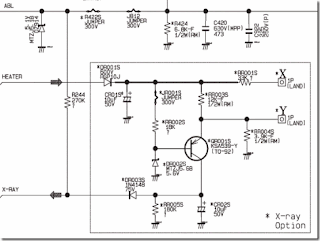
    X-ray Protect (option). Sampled using a heater voltage of the circuit as shown below. Normal vltage in x-ray path to the base of Q902 is zero.
    Samsung TV Protect Circuit

    ABL protect. If there is damage to flyback voltage which can cause a high rise ABL, then protect circuit will actively work.
    Read More..