Showing posts with label stereo. Show all posts

Wednesday, December 25, 2013

18W Car Stereo Amplifier Rise

This automobile stereo amplifier project is a class AB audio power amplifier using the Hitachi HA13118 module. It not only can be used in automobile application but also in any transportable or home amplifier process. It is simple to construct & has a maximum of outside parts. The module has a high power output from a low voltage supply using the bridge tied load system, & a high gain of 55dB.

This project will be useful in applications where the input signal is a low level, without requiring the use of a separate pre-amplifier. This IC module has a built in surge protection circuit, thermal shutdown circuit, ground fault protection circuit & power supply fault protection circuit making it reliable.
The Specifications of this project 
D.C. Input : 8 – 18V at 1-2 A

Power output : 18W maximum, 4 ohm load, 18V DC supply

S/N ratio : > 70 dB

THD : < 0.2% @ 1W

Freq. Response : ~ 30 Hz to 30 kHz, –3 dB

Input level : < 25 mV, for full output (G > 50dB)

Input Impedance : ~ 30 k ohm

The supply voltage necessary for this project is 8 -18V DC, at least one to two Amps. Maximum output power will only be obtained with a power supply of 18V at greater than two A, using a four ohm speaker. The power supply ought to be well filtered to reduce mains hum, a regulated supply will reduce noise even further. Additional filtering is unnecessary if operating from a battery supply.

Circuit Diagram Description

Most of the circuitry is contained within the amplifier module. C10 is the input coupling capacitor and blocks DC from the input. C11 bypasses any RF which may be present at the input. C1 & C2 provide an AC ground for the inverting inputs of the IC. R1/C7 and R2/C8 provide a high frequency load for stability with difficult speakers. C five & C six provide bootstrap feedback for the IC. C9 & C12 provide power supply filtering.

18W Car Stereo Amplifier (Rise)

An externally mounted logarithmic potentiometer of between 10k ohm and 50k ohm, is used depending on the desired input impedance. The impedance ought to be keep as high as feasible for a guitar amp, unless using a separate pre-amp. Make sure-that the heat sink is mounted to the module.


Read More..

Monday, December 23, 2013

Quality Stereo Wireless Microphone or Audio Link

This stereo FM wireless microphone also makes a great quality audio link. We tested it to beyond 50 meters and it was rock solid. It’s certainly not the first wireless microphone we’ve ever published but this one is a little different. It’s stereo, providing surprisingly good quality sound. Second, it has a really good range. We tested it at well over 50m and it was still performing very well – noise-free, in fact – but at the time we couldn’t get our receiver any further away. So it’s likely to have even better range than that.

Complete Project:

quality stereo wireless microphone or audio link schematic circuit diagram

Its easy to build, requires very little setup... and its cheap! In fact, the low price might turn some people off, thinking its low quality. Try it - and be pleasantly surprised! Third, it really is simple to build – the hard work (the transmitter module) is already done for you. It’s just a matter of assembling the microphone module, which contains the electret mics themselves, preamp and level controls, and soldering the transmitter module onto it, "piggy back" style.

FM Transmitter:


Finally, the transmitter module is crystal-locked, so you won’t have the drift probles of some earlier wireless microphones. And just in case you were wondering, that doesn’t mean the output is locked to one particular frequency – it has a nifty synthesis circuit built in to give you the choice of seven different frequencies between 106.7MHz and 107.7MHz. On-board preset pots adjust the sensitivity of each channel to take into account mic differences or if you require different levels in each channel.

FM transmitter circuit schematic

By the way, the transmitter module is quite capable of operating at line level if you want just a line level transmitter (eg, to feed an audio program around your home). Sensitivity is about 100mV. Oatley Electronics, who designed the kit, have the transmitter module available by itself if that’s what you’re after. But more on that anon.

FM transmitter circuit schematic

Parts Layout:

FM transmitter circuit schematic

FM transmitter circuit schematic

You also have the choice of two power supply levels – 3-6V or 7-15V DC. The latter results in a lower current drain. The transmitter module also has a "5V out" rail to supply power to the preamp module.

Circuit Diagram:

Quality Stereo Wireless Microphone or Audio Link Schematic Circuit Diagram

Two electret microphone inserts are supplied in the kit. These can be soldered direct to the PC board to make it a fully self-contained project or they can be attached to the board via suitable lengths of mini shielded coax cable. A third option is to use "proper" microphones – they can be electret or dynamic types – but no provision has been made for plugging these in.

Typical Specifications:

Audio response:.....................20Hz-15kHz.
Channel separation: ........................40dB
Total Harmonic Distortion: ...............0.1%
Output Frequency:...........106.7-107.2MHz
Pre Emphasis: ..................................50μS
DC supply voltage range: ................3-15V
Supply Current: .......................30mA @ 9V
Source: Silicon Chip 28 May 2005
Read More..

Tuesday, September 3, 2013

Stereo Headphone Amplifier Using LM4882

Using the LM48824 integrated circuit , can be designed a very simple stereo headphone amplifier for portable devices .

Stereo Headphone Amplifier Circuit diagram

The LM48824’s Stereo Headphone Amplifier (Class G architecture ) increases audio (MP3, mobile TV, etc.) playback time with its adaptive power supply approach that enables very low supply rails, which doubles the power-efficiency compared to typical Class AB headphone amplifiers.

A high output impedance mode allows the LM48824s outputs to be driven by an external source without degrading the signal.
Read More..

Friday, August 9, 2013

3 Watt stereo amplifier circuit

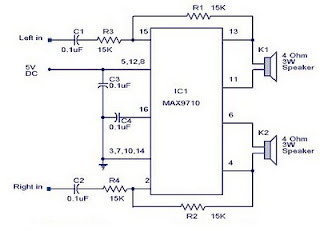
3 Watt stereo amplifier circuit using MAX 7910 IC. The MAX9710 a stereo audio power amplifier IC capable of delivering 3Watts of out put to 4 Ohm loads. MAX9710 can be operated from a single 4.5V to 5.5V power supply , makes it ideal for hand held applications.The IC for 3 Watt stereo amplifier circuit also features thermal overload protection.


Circuit Schematics 3 Watt  Stereo Amplifier MAX 7910 
3 Watt stereo amplifier circuit
3 Watt stereo amplifier circuit 

This 3 Watt stereo amplifier circuit  is suitable for small power audio devices such as radio sets and portable CD players. 5 V DC power supply is used for powering the 3 Watt stereo amplifier circuit. 6V battery with an IN 4007 diode series to the positive terminal of it can also be used instead of 5 V DC supply. The 3 Watt stereo amplifier circuit will get a supply voltage approximately 5 V after 0.7 V voltage drop across diode.

Read More..

Tuesday, August 6, 2013

Stereo Power Amplifier Circuit based on BA5417

BA5417 is a stereo amplifier IC with a lot of good features like thermal shut down, standby function, soft clipping, wide operating voltage range etc. The IC can deliver 5W per channel into 4 ohm loud speakers at 12V DC supply voltage. The BA5417 has excellent sound quality and low THD (total harmonic distortion) around 0.1% at F=1kHz; Pout=0.5W.

Stereo Power Amplifier  Circuit diagram :

stereo-amplifier-circuit BA5417-

Setup and working of this stereo power amplifier circuit is somewhat similar to the BA5406 based stereo amplifier circuit published previously. C10 and C11 are DC decoupling capacitors which block any DC level present in the input signals. C2 and C6 couples the amplifiers left and right power outputs to the corresponding loud speakers. C1 and C5 are bootstrap capacitors.

Bootstrapping is a method in which a portion of the amplifiers is taken and applied to the input. The prime objective of bootstrapping is to improve the input impedance. Networks R1,C3 and R2,C7 are meant for improving the high frequency stability of the circuit. C4 is the power supply filter capacitor. S1 is the standby switch. C8 is a filter capacitor. R3 and R4 sets the gain of the left and right channels of the amplifier in conjunction with the 39K internal feedback resistors.
Note :
  • Supply voltage range of BA5417 is from 6 to 15V DC.
  • The recommended supply voltage for this circuit is 12V DC.
  • The power supply must be well regulated and filtered.
  • BA5417 requires a heatsink.
  • The circuit can be assembled on a perf board without much degradation in performance.

Source : http://www.ecircuitslab.com/2012/07/stereo-power-amplifier-circuit-based-on.html
Read More..

Saturday, April 6, 2013

TDA2004 stereo bridge audio amplifier

tda2004 bridge
Most of the lovers, especially in audio electronics, it will never escape from this one component of the IC TDA2004. Because these components are very easy to get and the price is also quite cheap. Amplfiier audio series was also quite easy to make because the circuit is not too complicated, and one ic also already has 2 outputs and inputs.

Not only that, the audio is processed from the IC is also well qualified, many power power branded car, using it as an amplifier ic. Nothing mistake this ic tried to make an audio amplifier. For the circuit scheme can be seen below.
schematic power amplifier with TDA2004
with this amplifier circuit you can easily enhance your audio levels, from your stereo walkman, Ipod, tuner, MP3 player or MP4, the portable receiver, laptops or PCs


Read More..

Tuesday, April 2, 2013

Stereo 30W STK ICs amplifier circuit

high power stk amplifier
This amplifier circuit based on IC STK ic used in which the manifold. And on this circuit ic STK has many similarities, you can use the STK430 ICs, 433, 435, 437, 439, 441, 443, 4332, 4352, 4362, 4372, 4392. Between the specify type IC STK, which has the excellent performance is STK433 and STK443 because it has output, and high amperage, and voltage problems Suplly but I chose IC STK443 because maximum voltage up to 70 volts, compared with the others that just under 60 volts. For a list of components can seen below.
Component List :

Resistor
R1_____1KΩ
R2_____1KΩ
R3_____120Ω
R4_____120Ω
R5_____330KΩ
R6_____22KΩ
R7_____22KΩ
R8_____330KΩ
R9_____12KΩ
R10____220KΩ
R11____220KΩ
R12____12KΩ
R13____100Ω
R14____4Ω7
R15____4Ω7

Capacitor
C1_____4µ7F
C2_____4µ7F
C3_____220µF
C4_____220µF
C5_____100µF
C6_____100µF
C7_____220µF
C8_____100µF
C9_____47µF
C10____47µF
C11____0.1µF
C12____0.1µF
C13____2200µF
C14____2000µF
**Orange on symbol capacitor is plus Elco**

IC
U1_____STK430 , STK433 , STK435 , STK437 , STK439 , STK441 , STK443 , STK4332 , STK4352 , STK4362 , STK4372 , STK4392.
Read More..