Showing posts with label audio. Show all posts

Monday, December 23, 2013

Quality Stereo Wireless Microphone or Audio Link

This stereo FM wireless microphone also makes a great quality audio link. We tested it to beyond 50 meters and it was rock solid. It’s certainly not the first wireless microphone we’ve ever published but this one is a little different. It’s stereo, providing surprisingly good quality sound. Second, it has a really good range. We tested it at well over 50m and it was still performing very well – noise-free, in fact – but at the time we couldn’t get our receiver any further away. So it’s likely to have even better range than that.

Complete Project:

quality stereo wireless microphone or audio link schematic circuit diagram

Its easy to build, requires very little setup... and its cheap! In fact, the low price might turn some people off, thinking its low quality. Try it - and be pleasantly surprised! Third, it really is simple to build – the hard work (the transmitter module) is already done for you. It’s just a matter of assembling the microphone module, which contains the electret mics themselves, preamp and level controls, and soldering the transmitter module onto it, "piggy back" style.

FM Transmitter:


Finally, the transmitter module is crystal-locked, so you won’t have the drift probles of some earlier wireless microphones. And just in case you were wondering, that doesn’t mean the output is locked to one particular frequency – it has a nifty synthesis circuit built in to give you the choice of seven different frequencies between 106.7MHz and 107.7MHz. On-board preset pots adjust the sensitivity of each channel to take into account mic differences or if you require different levels in each channel.

FM transmitter circuit schematic

By the way, the transmitter module is quite capable of operating at line level if you want just a line level transmitter (eg, to feed an audio program around your home). Sensitivity is about 100mV. Oatley Electronics, who designed the kit, have the transmitter module available by itself if that’s what you’re after. But more on that anon.

FM transmitter circuit schematic

Parts Layout:

FM transmitter circuit schematic

FM transmitter circuit schematic

You also have the choice of two power supply levels – 3-6V or 7-15V DC. The latter results in a lower current drain. The transmitter module also has a "5V out" rail to supply power to the preamp module.

Circuit Diagram:

Quality Stereo Wireless Microphone or Audio Link Schematic Circuit Diagram

Two electret microphone inserts are supplied in the kit. These can be soldered direct to the PC board to make it a fully self-contained project or they can be attached to the board via suitable lengths of mini shielded coax cable. A third option is to use "proper" microphones – they can be electret or dynamic types – but no provision has been made for plugging these in.

Typical Specifications:

Audio response:.....................20Hz-15kHz.
Channel separation: ........................40dB
Total Harmonic Distortion: ...............0.1%
Output Frequency:...........106.7-107.2MHz
Pre Emphasis: ..................................50μS
DC supply voltage range: ................3-15V
Supply Current: .......................30mA @ 9V
Source: Silicon Chip 28 May 2005
Read More..

Sunday, December 22, 2013

Moduler Audio Preamplifier

High Quality, Discrete Components Design, Input and Tone Control Modules
To complement the 60 Watt MosFet Audio Amplifier a High Quality Preamplifier design was necessary. A discrete components topology, using + and - 24V supply rails was chosen, keeping the transistor count to the minimum, but still allowing low noise, very low distortion and high input overload margin. Obviously, the modules forming this preamplifier can be used in different combinations and drive different power amplifiers, provided the following stages present a reasonably high input impedance (i.e. higher than 10KOhm).

Main Module:
If a Tone Control facility is not needed, the Preamplifier will be formed by the Main Module only. Its input will be connected to some sort of changeover switch, in order to allow several audio reproduction devices to be connected, e.g. CD player, Tuner, Tape Recorder, iPod, MiniDisc etc. The total amount and type of inputs is left to the choice of the home constructor. The output of the Main Module will be connected to a 22K Log. potentiometer (dual gang if a stereo preamp was planned). The central and ground leads of this potentiometer must be connected to the power amplifier input.

Main Module Circuit diagram:
Main Module Circuit Diagram
Parts:
R1_____________1K5 1/4W Resistor
R2_____________220K 1/4W Resistor
R3_____________18K 1/4W Resistor
R4_____________330R 1/4W Resistor
R5_____________39K 1/4W Resistor
R6_____________56R 1/4W Resistor
R7,R10_________10K 1/4W Resistors
R8_____________33K 1/4W Resistor
R9_____________150R 1/4W Resistor
R11____________ 6K8 1/4W Resistor
R12,R13________100R 1/4W Resistors
R14____________100K 1/4W Resistor
C1_____________220nF 63V Polyester Capacitor
C2_____________220pF 63V Polystyrene or ceramic Capacitor
C3_____________1nF 63V Polyester or ceramic Capacitor
C4,C7__________47µF 50V Electrolytic Capacitors
C5,C6__________100µF 50V Electrolytic Capacitors
Q1,Q2__________BC550C 45V 100mA Low noise High gain NPN Transistors
Q3_____________BC556 65V 100mA PNP Transistor
Q4_____________BC546 65V 100mA NPN Transistor

Tone Control Module:

This Module employs an unusual topology, still maintaining the basic op-amp circuitry of the Main Module with a few changes in resistor values. A special feature of this circuit is the use of six ways switches instead of the more common potentiometers: in this way, precise "tone flat" setting, or preset dB steps in bass and treble boost or cut can be obtained. Tone Control switches also allow a more precise channel matching when a stereo configuration is used, avoiding the frequent poor alignment accuracy presented by common ganged potentiometers. Six ways (two poles for stereo) rotary switches were chosen for this purpose as easily available. This dictated the unusual "asymmetrical" configuration of three positions for boost, one for flat and two for cut.
This choice was based on the fact that tone controls are used in practice more for frequency boosting than for cutting purposes. In any case, +5dB +10dB and +15dB of bass boost and -3dB and -10dB of bass cut were provided. Treble boost was also set to +5dB +10dB and +15dB and treble cut to -3.5dB and -9dB. Those wishing to use common potentiometers in the usual way for Tone Controls may use the circuit shown enclosed in the dashed box (bottom-right of the Tone Control Module circuit diagram) to replace switched controls. The Tone Control Module should usually be placed after the Main Input Module, and the volume control inserted between the Tone Control Module output and the power amplifier input. Alternatively, the volume control can also be placed between Main Input Module and Tone Control Module, at will. Furthermore, the position of these two modules can be also interchanged.

Tone Control Module Circuit diagram:

Tone Control Module Circuit Diagram

Parts:
R1,R7___________47K 1/4W Resistors
R2_____________220K 1/4W Resistor
R3______________18K 1/4W Resistor
R4_____________330R 1/4W Resistor
R5______________39K 1/4W Resistor
R6______________56R 1/4W Resistor
R8_____________150R 1/4W Resistor
R9______________10K 1/4W Resistor
R10,R16__________6K8 1/4W Resistors
R11,R12________100R 1/4W Resistors
R13____________100K 1/4W Resistor
R14______________1K5 1/4W Resistor
R15,R21,R22______4K7 1/4W Resistors
R17,R24,R26______8K2 1/4W Resistors
R18______________3K3 1/4W Resistor
R19______________1K 1/4W Resistor
R20____________470R 1/4W Resistor
R23,R25_________12K 1/4W Resistors
R27,R28__________4K7 1/4W Resistors
C1_____________220nF 63V Polyester Capacitor
C2_______________1nF 63V Polyester or ceramic Capacitor
C3,C6___________47µF 50V Electrolytic Capacitors
C4,C5__________100µF 50V Electrolytic Capacitors
C7______________10nF 63V Polyester Capacitor
C8,C9__________100nF 63V Polyester Capacitors
Q1,Q2_________BC550C 45V 100mA Low noise High gain NPN Transistors
Q3____________BC556 65V 100mA PNP Transistor
Q4____________BC546 65V 100mA NPN Transistor
SW1,SW2_______2 poles 6 ways Rotary Switches
Simpler, alternative Tone Control parts:
P1______________22K Linear Potentiometer
P2______________47K Linear Potentiometer
R29,R30________470R 1/4W Resistors
R31,R32__________4K7 1/4W Resistors
C10_____________10nF 63V Polyester Capacitor
C11,C12________100nF 63V Polyester Capacitors

Power supply:
The preamplifier must be feed by a dual-rail, +24 and -24V 50mA dc power supply. This is easily achieved by using a 48V 3VA center-tapped mains transformer, a 100V 1A bridge rectifier and a couple of 2200µF 50V smoothing capacitors. To these components two 24V IC regulators must be added: a 7824 (or 78L24) for the positive rail and a 7924 (or 79L24) for the negative one. The diagram of such a power supply is the same of that used in the Headphone Amplifier, but the voltages of the secondary winding of the transformer, smoothing capacitors and IC regulators must be uprated. Alternatively, the dc voltage can be directly derived from the dc supply rails of the power amplifier, provided that both 24V regulators are added.

Note:
If this preamplifier is used as a separate, stand-alone device, thus requiring a cable connection to the power amplifier, some kind of output short-circuit protection is needed, due to possible shorts caused by incorrect plugging. The simplest solution is to wire a 3K3 1/4W resistor in series to the output capacitor of the last module (i.e. the module having its output connected to the preamp main output socket).

Technical data:

Main Module Input sensitivity:
250mV RMS for 1V RMS output
Tone Control Module Input sensitivity:
1V RMS for 1V RMS output
Maximum output voltage:
13.4V RMS into 100K load, 11.3V RMS into 22K load, 8.8V RMS into 10K load
Frequency response:
flat from 20Hz to 20KHz
Total harmonic distortion @ 1KHz:
1V RMS 0.002% 5V RMS 0.003% 7V RMS 0.003%
Total harmonic distortion @10KHz:
1V RMS 0.003% 5V RMS 0.008% 7V RMS 0.01%

Source :http://www.ecircuitslab.com/2011/06/moduler-audio-preamplifier.html  
Read More..

Wednesday, August 14, 2013

Audio Booster

The amplifiers gain is nominally 20 dB. Its frequency response is determined primarily by the value of just a few components-primarily C1 and R1. The values of the schematic diagram provide a response of ±3.0 dB from about 120 Hz to better than 20,000 Hz.Actually, the frequency response is ruler flat from about 170 Hz to well over 20,000 Hz; its the low end that deviates from a flat frequency response.

The low ends roll-off is primarily a function of capacitor C1(since RIs resistive value is fixed). If C1s value is changed to 0.1 pF, the low ends comer frequency-the frequency at which the low-end roll-off starts-is reduced to about 70 Hz. If you need an even deeper low-end roll-off, change C1 to a 1.0 pF capacitor; if its an electrolytic type, make certain that its installed into the circuit with the correct polarity, with the positive terminal connected to Q1s base terminal
.

Parts:

P1 = 100K
R1 = 47K
R2 = 470K
R3 = 10K
R4 = 560R
R5 = 270R
C1 = 0.1uF-25v
C2 = 3.3uF-25v
C3 = 470uF-25V
D1 = 5mm. Red Led
B1 = 9v Battery
J1 = RCA Audio Input Socket
J2 = RCA Audio Output Socket
S1 = On-Off Switch


Read More..

Tuesday, August 13, 2013

10 Watts Mosfet Audio Amplifier

10 Watts Mosfet Audio Amplifier

The diagram shown here is a MOSFET amplifier circuit 10W of sound that only requires a single source. Single railway material rarely used in power amplifiers class-B. However, for low power applications like this is very thin. Actually I have this circuit a old cassette player is still working and republish as it is. The BD512 and BD522 power MOSFETs is obsolete now and you can use any other power MOSFET game instead of them.


Transistors Q1 and Q2 are connected as a Darlington pair works as a preamp. R3 preset controls the quiescent current, while R2 provides. Output is coupled to the speakers through capacitor C4. Capacitor C5 is the power supply filter and C2 is the input DC decoupling capacitor.


Notes.

  • The circuit can be assembled on a vero board.
  • Use 30V DC for powering the circuit.
  • Do not expect much performance from this amplifier.
  • Capacitors C3, C4, C5 must be rated 50V and C2 can be 10V.
  • Use a 8 ohm 15W speaker as load.
Read More..

Monday, August 12, 2013

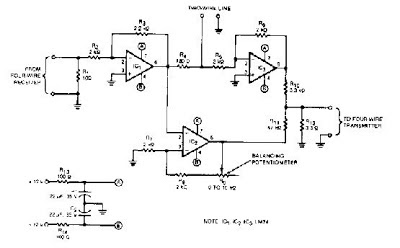
How to Build a 2 to 4 Wire Audio Converter

This audio converter circuit maintains 40 dB of isolation between the two halves of entry and exit of a four-line son, while allowing a line connecting two son. A balancing potentiometer, R, adjusts the gain of zero lC2to crossing the inlet to the outlet .

The adjustment is done in terms of work just after installation by inserting a 1 kHz tone at the entrance of four son and setting R to the minimum output signal 82-ohm dummy-load resistor is placed between two wire terminals .

 2 to 4 Wire Audio Converter Circuit Diagram

How to Build a 2 to 4 Wire Audio Converter

Read More..

TBA820 low power audio amplifier

TBA820 , KA2201 , LM820 , U820 amplifier
At this time amplifier circuit based on IC KA2201, TBA820M, LM820M, and U820. You can use all ic is the series under the scheme. This amplifier circuit has a very small output power or low at 2W. Required supply voltage from 3 volts to a maximum of 16 volts.


Below is a scheme of this power amplifier

TBA820 , KA2201 , LM820 , U820 rangkaian amplifier
Part List
R1 = 100K
R2 = 120R
R3 = 100R
C1 = 100nF
C2 = 100uF
C3 = 470uF
C4 = 220pF
C5 = 47uF
C6 = 100uF
IC = KA2201 , LM820M , TBA820M , U820M
Read More..

Friday, August 9, 2013

Audio Controlled Mains Switch

It is often useful for audio or video equipment to be switched off automatically after there has been no input signal for a while. The function of the on-off switch in such equipment is then taken over by switch S2 in the accompanying diagram. It remains, however, possible to  switch off manually by means of Si. Automatic  switch-off occurs after there has been no input  signal for about 2 minutes: this delay makes it possible for a new record or cassette to be placed in the  relevant machine.
 
The audio input to the proposed circuit may be  taken from the output of the relevant TV set, amplifier, or whatever. The input earth is held at + 6 V  with respect to the circuit earth by potential divider  Ri-R2-R3-R4. The two 741s function as comparators: the output of ICi goes high when the in- put signal is greater than + 50 mV, whereas the out- put of IC2 goes high when the input signal  becomes more negative than -50 mV. Resistors  R6, R7, and R8 form an OR gate that drives transistor Ti. If the output of either ICi or IC2 is logic  1, Ti conducts.
 
Circuit diagram :
Audio-Controlled-Mains-Switch-Circuit-Diagram
Audio Controlled Mains Switch Circuit Diagram

The 555  operates as a retrigger able monostable,  whose period is determined by Rio and Ci. The  device is triggered when its pin 2 is earthed by the  closing of S2. Its output, pin 3, then remains high  for 1 to 2 minutes, depending on the leakage cur- rent of the 555. 

The monostable resets itself as soon  as the potential across Ci exceeds a certain value.  As long as there is an input signal to the circuit, Ti conducts and Ci remains uncharged. As soon as  the audio signal ceases, Ti switches off, and Ci  charges until the potential across it is sufficient to  reset the 555. The monostable may also be reset by  closing Si, which connects pin 6 of the 555 to + 12 V.
 
Audio-Controlled-Mains-Switch
 
When IC3 is reset, Ci is discharged via its pin 7. Resistor Rrn serves as protection, because without it Ti could short-circuit the supply lines. When the output of IC3 goes high, T2 conducts,  the relay is energized, and the relay contacts switch on the mains voltage as appropriate. To counter the induced potential when the relay contacts close, which could damage T2, diode Di has been connected in parallel with the relay coil.


Source by : Streampowers
Read More..

Tuesday, August 6, 2013

High Voltage 3 Watt Audio Power Amplifier Circuit

The LM4954 is an audio power amplifier primarily designed for demanding applications in mobile phones and other portable communication device applications. It is capable of delivering 2.4 Watts of continuous average power to an 8 BTL load with less than 1% THD+N from a 7VDC power supply.

Boomer audio power amplifiers are designed specifically to provide high quality output power with a minimal number of external components. The LM4954 does not require output coupling capacitors or bootstrap capacitors, and therefore is ideally suited for lower-power portable applications where minimal space and power consumption are primary requirements.

Circuit   Diagram:

High Voltage 3 Watt Audio Power Amplifier Circuit High Voltage 3 Watt Audio Power Amplifier Circuit Diagram

The LM4954 features a low-power consumption global shutdown mode which is achieved by driving the shutdown pin with logic low. Additionally, the LM4954 features an internal thermal shutdown protection mechanism.

The LM4954 contains advanced pop & click circuitry which eliminates noises that would otherwise occur during turn-on and turn-off transitions.

The LM4954 is unity-gain stable and can be configured by external gain-setting resistors.

Key Specification:

Wide Power Supply Voltage Range 2.7 <= VDD <= 9V
Output Power: VDD = 7V, 1% THD+N 2.4W (typ)
Quiescent power supply current 3mA (typ)
PSRR: VDD = 5V and 3V at 217Hz 80dB (typ)
Shutdown power supply current 0.01µA (typ)


Features:

  • No output coupling capacitors, snubber networks or bootstrap capacitors required
  • Unity gain stable
  • Externally configurable gain
  • Ultra low current active low shutdown mode
  • BTL output can drive capacitive loads up to 100pF
  • "Click and pop" suppression circuitry
  • 2.7V - 9.0V operation
  • Available in space-saving microSMD package
  • Applications

  • Mobile Phones
  • PDAs
  • Source:national

    Read More..

    Best Audio Compressor Circuit Diagram

    This Best Audio Compressor Circuit Diagram 2-band compressor splits the audio into high and low frequencies and allows independent adjustment of each. TVo active filters drive the two halves of dual voltage controlled amplifier/rectifier IC. Each section has a dynamic range greater than 100 dB. Compression gain slopes are adjustable from 2 to 25 for both audio bands. iB adjusts the threshold amplitude between the two bands. RK1 and R2/C2 control the compressor attack times (10 kfl and 2, respectively), while the 1.5- resistor in the integrator circuit controls the release line.

     Best Audio Compressor Circuit Diagram

    Best Audio Compressor Circuit Diagram
     
    Read More..

    Thursday, August 1, 2013

    Audio Powered Noise Clipper Circuit Diagram

    Audio Powered Noise Clipper Circuit Diagram.Tl and T2 are 600 to 8 ohm transformers (any transistor radio output transformers with 500 to 4 ohm impedance may be used). Ql is a 2N2222 npn transistor, and Q2 is a 2N2907 pnp transistor. Dl and D2 1N270 signal diodes (HEP 134 or 135). Two transistors, powered by the audio power contained within the signal, will clip signal peaks which exceed the threshold established by the 2.5 potentiometer. 

    The diodes isolate the positive and negative clipping circuits represented by the npn and pnp transistors, respectively. A desired audio operating level can be established and the potentiometer needs little or no further adjustment. 

     Audio Powered Noise Clipper Circuit Diagram

    Audio Powered Noise Clipper Circuit Diagram
     
    Read More..

    Wednesday, July 31, 2013

    6 12 Volt audio amplifier

    6 - 12 Volt amplifier circuit
    The above is an amplifier circuit using supply voltages from 6 volts DC to 12 Volt DC. Power output of the amplifier is quite low with only 1 Watt 8 ohm impedance. You can apply this to the audio signal amplifiers that require strengthening are not so large as in the pocket radio.
    Part List :
    R1 =  100K
    R2 = 39R
    R3 = 100R
    C1 = 100nF
    C2 = 100uF
    C3 = 100uF
    C4 = 100uF
    C5 = 470uF
    C6 = 100nF
    C7 = 68pF
    C8 = 1nF
    C9 = 47uF
    IC = SFC2790C
    Read More..

    Monday, April 8, 2013

    LM4990 2 Watt Audio Power Amplifier with Selectable Shutdown Logic Level

    The LM4990 is an audio power amplifier primarily designed for demanding applications in mobile phones and other portable communication device applications. It is capable of delivering 1.25 watts of continuous average power to an 8Ω BTL load and 2 watts of continuous average power (LD and MH only) to a 4Ω BTL load with less than 1% distortion (THD+N+N) from a 5VDC power supply. Boomer audio power amplifiers were designed specifically to provide high quality output power with a minimal amount of external components. The LM4990 does not require output coupling capacitors or bootstrap capacitors, and therefore is ideally suited for mobile phone and other low voltage applications where minimal power consumption is a primary requirement.
    Circuit Diagram :
    2 Watt Audio Power Amplifier with Selectable Shutdown Logic Level  2 Watt Audio Power Amplifier with Selectable Shutdown Logic Level
    The LM4990 features a low-power consumption shutdown mode. To facilitate this, Shutdown may be enabled by either logic high or low depending on mode selection. Driving the shutdown mode pin either high or low enables the shutdown pin to be driven in a likewise manner to enable shutdown. The LM4990 contains advanced pop & click circuitry which eliminates noise which would otherwise occur during turn-on and turn-off transitions. The LM4990 is unity-gain stable and can be configured by external gain-setting resistors.
     Features

  • Available in space-saving packages: LLP, Exposed-DAP TSSOP, MSOP, and ITL


  • Ultra low current shutdown mode


  • Improved pop & click circuitry eliminates noise during turn-on and turn-off transitions


  • 2.2 - 5.5V operation


  • No output coupling capacitors, snubber networks or bootstrap capacitors required


  • Unity-gain stable


  • External gain configuration capability


  • User selectable shutdown High or Low logic Level
    Key Specification
    Improved PSRR at 217Hz & 1KHz  62dB
    Power Output at 5.0V, 1% THD+N, 4Ω (LD and MH only) 2W (typ)
    Power Output at 5.0V, 1% THD+N, 8Ω 1.25W (typ)
    Power Output at 3.0V, 1% THD+N, 4Ω 600mW (typ)
    Power Output at 3.0V, 1% THD+N, 8Ω 425mW (typ)
    Shutdown Current 0.1µA (typ)

    Applications

    • Mobile Phones
    • PDAs
    • Portable electronic devices
    Datasheets
    Source: www.national.com

    Read More..

    Saturday, April 6, 2013

    TDA2004 stereo bridge audio amplifier

    tda2004 bridge
    Most of the lovers, especially in audio electronics, it will never escape from this one component of the IC TDA2004. Because these components are very easy to get and the price is also quite cheap. Amplfiier audio series was also quite easy to make because the circuit is not too complicated, and one ic also already has 2 outputs and inputs.

    Not only that, the audio is processed from the IC is also well qualified, many power power branded car, using it as an amplifier ic. Nothing mistake this ic tried to make an audio amplifier. For the circuit scheme can be seen below.
    schematic power amplifier with TDA2004
    with this amplifier circuit you can easily enhance your audio levels, from your stereo walkman, Ipod, tuner, MP3 player or MP4, the portable receiver, laptops or PCs


    Read More..

    Friday, April 5, 2013

    Audio Controlled Mains Switch

    It is often useful for audio or video equipment to be switched off automatically after there has been no input signal for a while. The function of the on-off switch in such equipment is then taken over by switch S2 in the accompanying diagram. It remains, however, possible to  switch off manually by means of Si. Automatic  switch-off occurs after there has been no input  signal for about 2 minutes: this delay makes it possible for a new record or cassette to be placed in the  relevant machine.
     
    The audio input to the proposed circuit may be  taken from the output of the relevant TV set, amplifier, or whatever. The input earth is held at + 6 V  with respect to the circuit earth by potential divider  Ri-R2-R3-R4. The two 741s function as comparators: the output of ICi goes high when the in- put signal is greater than + 50 mV, whereas the out- put of IC2 goes high when the input signal  becomes more negative than -50 mV. Resistors  R6, R7, and R8 form an OR gate that drives transistor Ti. If the output of either ICi or IC2 is logic  1, Ti conducts.
     
    Circuit diagram :
    Audio-Controlled-Mains-Switch-Circuit-Diagram
    Audio Controlled Mains Switch Circuit Diagram

    The 555  operates as a retrigger able monostable,  whose period is determined by Rio and Ci. The  device is triggered when its pin 2 is earthed by the  closing of S2. Its output, pin 3, then remains high  for 1 to 2 minutes, depending on the leakage cur- rent of the 555. The monostable resets itself as soon  as the potential across Ci exceeds a certain value.  As long as there is an input signal to the circuit, Ti conducts and Ci remains uncharged. As soon as  the audio signal ceases, Ti switches off, and Ci  charges until the potential across it is sufficient to  reset the 555. The monostable may also be reset by  closing Si, which connects pin 6 of the 555 to + 12 V.
     
    Audio-Controlled-Mains-Switch

    When IC3 is reset, Ci is discharged via its pin 7. Resistor Rrn serves as protection, because without it Ti could short-circuit the supply lines. When the output of IC3 goes high, T2 conducts,  the relay is energized, and the relay contacts switch on the mains voltage as appropriate. To counter the induced potential when the relay contacts close, which could damage T2, diode Di has been connected in parallel with the relay coil.


    http://streampowers.blogspot.com/2012/06/audio-controlled-mains-switch.html
    Read More..