Showing posts with label to. Show all posts

Monday, December 23, 2013

4 Bit Analogue to Digital Converter

The operation of the converter is based on the weighted adding and transferring of the analogue input levels and the digital output levels. It consists of comparators and resistors. In theory, the number of bits is unlimited, but each bit needs a comparator and several coupling resistors. The diagram shows a 4-bit version. The value of the resistors must meet the following criteria:
  • R1:R2 = 1:2;
  • R3:R4:R5 = 1:2:4;
  • R6:R7:R8:R9 = 1:2:4:8.
The linearity of the converter depends on the degree of precision of the value of the resistors with respect to the resolution of the converter, and on the accuracy of the threshold voltage of the comparators. This threshold level must be equal, or nearly so, to half the supply voltage. Moreover, the comparators must have as low an output resistance as possible and as high an input resistance with respect to the load resistors as feasible. Any deviation from these requirements affects the linearity of the converter adversely.

4-Bit Analogue to Digital Converter Circuit diagram :


If the value of the resistors is not too low, the use of inverters with an FET (field-effect transistor) input leads to a near-ideal situation. In the present converter, complementary metal-oxide semiconductor (CMOS) inverters are used, which, in spite of their low gain, give a reasonably good performance. If standard comparators are used, take into account the output voltage range and make sure that the potential at their non-inverting inputs is set to half the supply voltage. If high accuracy is a must, comparators Type TLC3074 or similar should be used. This type has a totem-pole output.

The non-inverting inputs should be interlinked and connected to the tap of a a divider consisting of two 10 kΩ resistors across the supply lines. It is essential that the converter is driven by a low-resistance source. If necessary, this can be arranged via a suitable op amp input buffer. The converter draws a current not exceeding 5 mA.

Source :http://www.ecircuitslab.com/2011/07/4-bit-analogue-to-digital-converter.html
Read More..

Saturday, December 21, 2013

Does not exist to bandwidth restrictions and limits the number of users

It is also the alternative solution for perfect cell phone jammer .
Operation of mobile TV technology. Core technology. For mobile TV technology, the very early abroad have begun to research. Japan in 1999 by a terrestrial broadcast digital television standard ISDB-T in Europe in 2002 began to study this standard, and in February 2004 by the DVB-H standard. South Korea in February 2003, clearly stated, "Digital Multimedia Broadcasting", and support standard named DMB, The country of Chinas mobile TV standard be introduced before the end of 2006. In October, the State Administration of Radio, Film and Television issued recommended standards: of STiMi technical standards. The formulation of these standards, to provide a basis for the development of mobile TV. It is for the supplementary installation method of perfect cell phone jammer on the outer wall.
At present, the core technology of mobile TV, is the network operator implementation. These technologies or standards, mainly in three ways: two-way communication that can use the mobile network, to provide users with personalized service; convenient right to business monitoring, management, accounting and control; do not change the phone hardware platform network bandwidth is limited, and could easily lead customers to compete for resources; low image resolution, image quality is affected by the impact of network bandwidth. Ground-based radio and television technology. Basically completed ready for commercialization. Does not exist to bandwidth restrictions and limits the number of users, high image quality; low sensitivity to the user, the capacity of the unexpected and emergency events. Usually there is no uplink, it is difficult to achieve the users personalized service. Adjust the distance between positions of installing perfect cell phone jammer .
Difficult to identify, control, interaction, billing and positioning services; terminal a digital television receiver unit must be increased. Have been commercialized for one year the use of satellites for mobile video broadcasting services more efficient; the satellites wide coverage. Personalized and interactive subject to certain constraints; terminal circuit module must be increased to be able to receive satellite TV signals. Based on the mobile communication network. In this way is actually through the mobile communication network using streaming media technology to achieve mobile TV program delivery, as well as the user on demand. The United States and Chinas mobile operators launched mobile TV services rely on the existing mobile network. Perfect cell phone jammer is hung inside the plant.
Read More..

Thursday, December 19, 2013

DC 6 5V to ±5V Converter

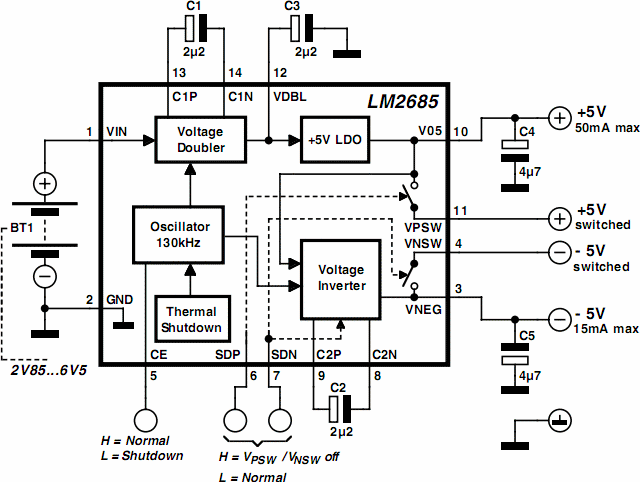
A symmetrical ±5V power supply is often needed for small, battery-operated operational amplifier projects and analogue circuits. An IC that can easily be used for this purpose is the National Semiconductor LM2685. It contains a switched-capacitor voltage doubler followed by a 5-V regulator. A voltage inverter integrated into the same IC, which also uses the switched-capacitor technique, runs from this output voltage. The external circuitry is limited to two pump capacitors and three electrolytic storage capacitors.

The IC can work with an input voltage between +2.85 V and +6.5 V, which makes it well suited for battery-operated equipment. The input voltage is first applied to a voltage doubler operating at 130 kHz. The external capacitor for this is connected to pins 13 and 14. The output voltage of this doubler is filtered by capacitor C3, which is connected to pin 12. If the input voltage lies between +5.4 and +6.5 V, the voltage doubler switches off and passes the input voltage directly through to the following +5-V low-dropout regulator, which can deliver up to 50mA.

DC 6.5V to ±5V Converter Circuit Diagram

C4 is used as the output filter capacitor. All that is necessary to generate the –5-V output voltage is to invert the +5-V voltage. This is done by a clocked power-MOS circuit that first charges capacitor C2, which is connected between pins 8 and 9, and then reverses its polarity. This chopped voltage must be filtered by C5 at the output. The unregulated –5 V output can supply up to 15 mA. The LM 2865 voltage converter IC also has a chip-enable input (CE) and two control inputs, SDP (shut down positive) and SDN (shut down negative).

If CE is set Low, the entire IC is switched off (shut down), and its current consumption drops to typically 6 µA. The CE input can thus be used to switch the connected circuit on or off, without having to disconnect the battery. The SDP and SDN inputs can be used to switch the VPSW and VNSW outputs, respectively. These two pins are connected to the voltage outputs via two low-resistance CMOS switches. This allows the negative output to be separately switched off, whereby the voltage inverter is also switched off. Switching off with SDP not only opens the output switch but also stops the oscillator.

There is thus no longer any input voltage for the –5 V inverter, so the –5 V output also drops out. The SDP and SDN inputs are set Low (< 0.8 V) for normal operation and High (>2.4 V) for switching off the associated voltage(s). The positive output of the LM 2865 is short-circuit proof. However, a short circuit between the positive and negative outputs must always be avoided. The IC is protected against thermal destruction by an over-temperature monitor. It switches off automatically at a chip temperature of around 150 oC. The full type number of the IC is LM 2685MTC. It comes in a TSSOP14 SMD package. National Semiconductor can be found on the Internet under www.national.com.

Read More..

Wednesday, December 18, 2013

Simple Frequency to Vvoltage Converter Circuit Diagram

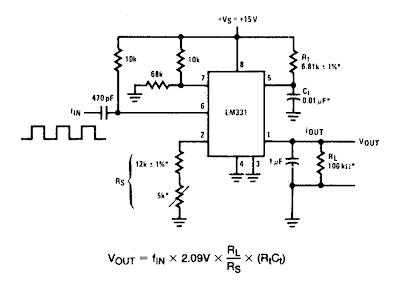
This is Simple Frequency to Vvoltage Converter Circuit Diagram. In these applications, a pulse input at % is differentiated by a C-R network and the negative-going edge at pin 6 causes the input comparator to trigger the timer circuit. Just as with a V-to-F converter, the average current flowing out of pin 1 is IaverAGE = i (1.1 RjC^ f. 

In this simple circuit, this current is filtered in the network RL = 100 k ohm and 1 µF. The ripple will be less than 10 mV peak, but the response will be slow, with a 0.1 second time constant, and settling of 0.7 second to 0.1%.


Simple Frequency to Vvoltage Converter Circuit Diagram

Simple Frequency to Vvoltage Converter Circuit Diagram


Simple Frequency to Vvoltage Converter Circuit Diagram
Read More..

Tuesday, December 17, 2013

The customer does not need to use cell phone jammer

The customer does not need to use cell phone jammer
In-depth development of high-tech industry clusters and innovation clusters to guide and role model, so that the industrial base to the development of high-tech industries in Xiamen "leading pack". Further play to the National Torch Plan-driven and demonstration of high-tech industries, mining Xiamen potential for industrial development, the declaration of Xiamen optoelectronic and electrical characteristics of industrial base, and foster new economic growth point, strengthen the science and technology to sustainable economic and social coordination to support the development and a leading role. With the development of mobile phones in the field of peoples lives began to play an increasingly irreplaceable role.Students through the card to achieve the schools internal consumption, school deployed a swipe card reader to read the information of the student card, automatic debit through the back office software, the system automatically sends the student consumer details and account balance information. The content of the message including student name, the amount of consumption, consumer locations, consumption patterns, time, balance. Account recharge transfers to remind. Card user account recharge or transfer the card system can be set up SMS alerts to remind users to recharge or transfer of relevant information. Includes student name, the amount of time, recharge the way, whether successful. The cell phone jammer system can change the background radio power value to the level value.
School subsidy payment reminder. The school issue related to grants, the system sends SMS alerts when deposited in the campus card accounts. Includes student name, the amount of time. The balance of early warning alerts. The system can be set for each card balance early warning function, when consumption is close to a predetermined amount, the system will automatically trigger the early warning mechanism, tell cardholders balance is running low, please recharge to avoid affecting the use, use the SMS method. Upstream business: that initiated by the user message, "One Card" system reply message. The campus card loss (UL). User campus card is lost, report the loss of command messages sent via cell phone to report the loss to the campus card system.Engel coefficient of rural residents dropped from 49.4% last year to 46.6%. This shows that regardless of urban residents or rural residents have consumer demand for mobile phone industry. With Jingzhou sustained economic development, it also has other aspects of consumption. This helps the mobile phone industry to expand and to explore the potential of Jingzhou consumption on the market of Jingzhou.
Read More..

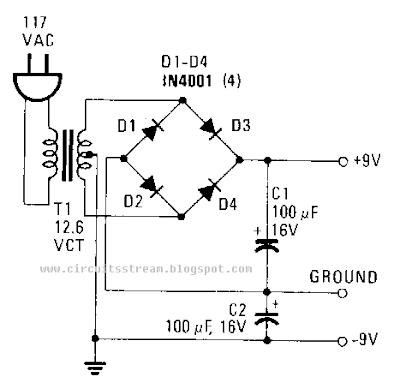
How to Build a Simple Power supply Circuit Diagram

To day i share this post how to Build a simple power-supply circuit diagram lets start . This simple power supply circuit diagram delivers plus and minus 9 V to replace two 9-V batteries. The rectifier circuit is actually two separate full-wave rectifiers fed from the secondary of the transformer. One full-wave rectifier is composed of diodes D1 and D2, which develop +9 V, and the other is composed of D3 and D4, which develop -9 V. 

Each .diode from every pair rectifies 6.3 Vac, half the secondary voltage, and charges the associated filter capacitor to the peak value of the ac waveform, 6.3 x 1.414 ~ 8.9 V. Each diode should have a PIV, Peak Inverse `Voltage, rating that is at least twice the peak voltage from the transformer, 2 x 8.9 ~ 18 V. The 1N4001 has a PIV of 50 V. I hope you are enjoy this circuit.

Simple Power supply Circuit Diagram

Simple Power supply Circuit Diagram


Read More..

Tuesday, September 3, 2013

500W Mos Fet Power Inverter from 12V to 110V 220V

Inverter Circuit Diagrams

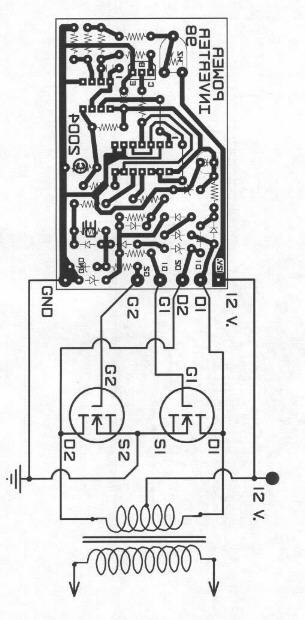
This circuit will provide a very stable "Square Wave" Output Voltage. Frequency of operation is determined by a pot and is normally set to 60 Hz. Various "off the shelf" transformers can be used. Or Custom wind your own FOR BEST RESULTS. Additional MosFets can be paralleled for higher power. It is recommended to Have a "Fuse" in the Power Line and to always have a "Load connected", while power is being applied. The Fuse should be rated at 32 volts and should be approximately 10 Amps per 100 watts of output. The Power leads must be heavy enough wire to handle this High Current Draw!

Inverter Circuit Diagrams

Appropriate Heat Sinks Should be used on the RFP50N06 Fets. These Fets are rated at 50 Amps and 60 Volts. ** Other types of Mosfets can be substituted if you wish. The LT1013 offers better drive that the LM358, but its your choice. The Power transformer must be capable of handling the chosen wattage output. Also, Appropriate Heat Sinks are Necessary on the Mos-Fets. Using a rebuilt Microwave transformer as shown below, it should handle about 500 watts Maximum. It requires about 18 turn Center-Tapped on the primary. To handle 500 watts would require using a 5 AWG wire. Pretty Heavy Stuff, but so is the current draw at that power.

Inverter Circuit Diagrams
Read More..

Monday, August 12, 2013

How to Build a 2 to 4 Wire Audio Converter

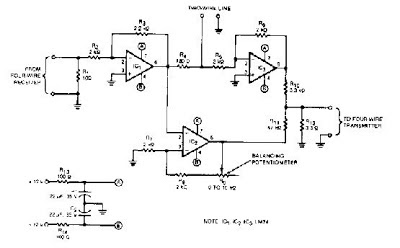
This audio converter circuit maintains 40 dB of isolation between the two halves of entry and exit of a four-line son, while allowing a line connecting two son. A balancing potentiometer, R, adjusts the gain of zero lC2to crossing the inlet to the outlet .

The adjustment is done in terms of work just after installation by inserting a 1 kHz tone at the entrance of four son and setting R to the minimum output signal 82-ohm dummy-load resistor is placed between two wire terminals .

 2 to 4 Wire Audio Converter Circuit Diagram

How to Build a 2 to 4 Wire Audio Converter

Read More..

Saturday, August 10, 2013

How to Manufacture Automobile Electronic Parts and Earn a Handsome Income


To set up an auto electrical manufacturing unit, its important to have a thorough knowledge regarding the various technicalities associated with the field. The article makes a comprehensive approach and explains all the issues related to the subject. We begin with the basic raw materials and man power required for the intended installations and further proceed with the list of electronic parts that can be manufactured and sold in the relevant markets. The products that are included for the production are flasher buzzers, piezo buzzers, CDI units, musical horns, auto testing machine etc. How these can be made is also explained through discrete articles, linked in the sections.


Among most electronic products, the ones which are associated with automobiles are probably the largest selling types and are always in demand. Manufacturing these items and selling is surely a lucrative business. Here we discuss the procedures in details.

Today one thing that’s common with all of us is that we all want to earn money. However, with the population that’s ever growing, all sources of earning money have been captured, resulting in a cut-throat competition in every field. It’s feasible to make a way out from this intense competition only if you can manage an area where you are the master, and are able to create a monopoly.
The auto market today has become huge and with tremendous opportunities, but also it’s flooded with some tough competitors. Since vehicles cannot work without electricity and other associated electronic accessories, the products related to these have cropped up extensively and you can find a whole range of all sorts of electronic products, some of which are mandatorily used while some are just for decoration purposes. Whatever may be the seriousness of the application, electronic products have become today an integral part with all types of vehicles.
Thus, auto electronics is probably one such field where you can expect some good money, provided you are equipped with all the know-how required for the initial manufacturing set ups.
In this article we are going to discus the technical aspects required for setting up an auto electronic manufacturing plant for TWO-WHEELERS and THREE-WHEELERS, small though. However here we won’t discuss the legal procedures involved, like acquiring VAT number, CST number etc.
The following steps provide some crucial data regarding earning money by manufacturing auto electrical products:


What Electronic Products can be Manufactured for the Two-Wheeler Auto Market?

There are probably a host of them which you can choose from, or rather go for the entire range. Supplying or keeping the whole range will provide you with a better chance of fairing among the many vying vendors.
The items commonly associated with two/three wheelers are the side indicators, CDI units, rectifiers, buzzers, melody maker horn, etc.
To begin a manufacturing plant for producing the above auto electrical items, you would first want to acquire a space with a descent area; preferably a 20 by 40 sq ft will be ideal and sufficient to begin with.
You would also require fixing some furniture in the form of a long narrow table closely attached to the longer wall and a few number of chairs that can be accommodated. This set up is required for implementing the production process by lining up the workers so that the assemblies can be done in the most efficient manner.
The workers who would be responsible for assembling the electronic parts will need important and useful tools like the soldering iron, wire nipper, wire stripper, soldering paste, thinner etc. so all these must be procured in required numbers.
The engineers may require more sophisticated tools like multitester, desolder pump/wik, magnifying glass, power supply etc. along with the above mentioned tools. Procure all of these as per the requirements.
We are assuming that the workers required for carrying out the procedures would be appropriately employed, so we are not discussing how they can be contacted and interviewed etc.
After the initial set ups as discussed above are done, it’s time to select the items and chalk out the procedures plans. It would include the following points:
There should be at least one product that has the potentials to run through out the year, under all odds. Make it the base of your company’s production line.
  As an example you may select the buzzer unit, as it’s the easiest to assemble, finish, and sell, moreover the concerned raw materials are easily available. However this product may carry pretty low profit margins and you would need to sell tons of them to actually witness any significant income, but can be rest assured a steady flow of income through out the season.
The circuit of an electronic buzzer is discussed  HERE, it’s the simplest in design and widely used all across the world for automobile applications, especially in conjunction with side turn signal or flasher units.
The next type of selected product would be the one which sells like “hot cake” in the market, has reasonably less competition and has the potentials of providing fairly high profit margins.
You can assess the product and insist the engineers to do improvements in the form of cost cutting or adding new features into the product, so that it can stand out from the rest of the brands. This will give you an edge while introducing your product in the market.
A flasher with buzzer is one such item which satisfies the above conditions, I have already published an improved and low cost flasher buzzer circuit in Bright Hub – You can check it out  HERE.
  CDI units are another indispensable auto part which can be manufactured and sold with good profit margins. You can find it in Bright Hub, just type the relevant words in the given in-site Google search box.


You can refer this article to know how to make a two-three wheeler CDI circuit.
Having discussed the manufacturing process, testing these circuits for accuracy and reliability can become a crucial issue. A suitable auto part testing machine therefore becomes imperative, without which the whole set up may fail or jeopardize.
If you inquire about such a universal auto part testing machine, you would probably get it at very high costs. In Pune (India), Teckson Electronics has the monopoly of manufacturing these machines, and they charge an awful Rs.12000/- for each of them.
I investigated the mechanism and developed my own version at less than Rs. 600/- which is more efficient, and more reliable than the above unit. The complete design will be comprehensively discussed in one of my forthcoming articles.
That’s all what may be basically required and concludes the fundamental technical procedures involved with setting up an electronic auto part manufacturing unit.


Read More..

Wednesday, August 7, 2013

How to Build Toxic Gas Detector and Alarm Circuit with TGS813

The danger always exists, when the fuel gases such as propane or gas are confined to a small area. The alarm of toxic gases figs. 1-45 utilizes a tin-oxide-semiconductor. A coil of thin wire heated by a battery 12 V via IC1 and IC2, which pulses the voltage to the coil of the sensor, saving a significant amount of energy. Diode Zener Dl provides a constant voltage to the filament coil sensor. resistance of the sensor reduces the sensor is exposed to toxic gases such as hydrogen, carbon

Carbon monoxide and propane. To reduce the resistance of the sensor, the SCR gate voltage increases. When the gate threshold voltage is reached, the SCR fires and a buzzer alarm is activated. Once activated, the bell and the switch S1 should be used to reset the alarm. Since the sensor has a good deal of thermal inertia, S1 must be off or open for about three or four minutes after the initial activation, allowing the sensor to stabilize, thus avoiding false alarms. R7 sensitivity control set to the desired value, before the activation of SCR.

How to Build Toxic Gas Detector and Alarm Circuit with TGS813

The toxic gas alarm is sensitive to less than 100 ppm of carbon monoxide. This alarm is useful for simple gas boats, sheds and cabins. You could save a life. Some of the companies listed in the Appendix to offer plans and kits for various toxic gas sensors.

Part List
Part Description
C1 0,01-MFD, 25-V capacitor (disc)
1 9-V zener diode D1 (NTE139A)
1 D2 4-V diode zener (NTE5068A)
1 SCR D3 (NTE5408)
1 Q1 Transistor 2N2222
U1 1 CD4013 CMOS flip-flop
1 U2 CD4049 CMOS Inverter Hex
1 siren piezo BUZ 6-9V
1 S1-TGS203 toxic gas sensor (Figaro or equivalent)

Read More..

Saturday, August 3, 2013

Build a 0 To 12V 1A Variable Power Supply Circuit Diagram

This 0- to 12-Vdc variable power supply uses an IC voltage regulator and a heavy-duty transformer to provide a reliable dc power supply. Looking at the schematic shown, you can sec that transformer Tl has a 120-V primary and a 28-V secondary. Filtered dc is fed to the input (pin 2) of the LM317T voltage regulator, IC, which keeps the voltage at its output constant (pin 3) regardless (within limitations) of the input voltage. 

Pin 1 of the LM317T is the adjustment pin. Varying the voltage on pin 1 (via PI) varies the output voltage. Diodes D5 through D7 and LEDs LI through L3 give an approximate indication of the output voltage. Each LED/diode path has a limiting resistor to limit the current to a level that is safe for the LED. 

 Build a 0 To 12V, 1A Variable Power Supply Circuit Diagram


Build a 0 To 12V, 1A Variable Power Supply Circuit Diagram
Read More..

Tuesday, July 30, 2013

Simple Current to voltage converter circuit Diagram

A filter removes the dc component of the rectified ac, which is then scaled to RMS

 Simple Current-to-voltage converter Circuit  Diagram


    Simple Current-to-voltage converter
Read More..

Tuesday, July 9, 2013

USB to Serial RS232 Adapter

This USB to Serial RS232 adapter is very useful in many situations we need to connect a device with RS232 to a computer without RS232 port , but with USB port .

Using FT232BM chip manufactured by Future Technology Devices International we can make a very simple USB to Serial RS232 adapter using few external components .
 
USB to Serial RS232 Adapter Circuit Diagram
 

This USB to RS232 adapter based on the FT232BM driver can support many operating systems ( windows , mac, linux ) .

FT232 driver main features are : Two Individually Configurable IO Channels , Integrated Power-On Reset (POR) circuit , Integrated RCCLK circuit , Integrated level converter on UART / FIFO interface and control signals , Support for Isochronous USB Transfers , Wake Up Signal Pin on each channel , Low suspend current , Programmable Receive Buffer Timeout , USB 2.0 , Extended EEPROM Support and many other.

As you can see in the schematic bellow the circuit is very simple and the voltage needed for the circuit is obtained from the USB port .

If you are using these type of USB to RS232 adapter you need to install a driver to work


Read More..

Friday, July 5, 2013

500W Mos Fet Power Inverter from 12V to 110V 220V

Inverter Circuit Diagrams

This circuit will provide a very stable "Square Wave" Output Voltage. Frequency of operation is determined by a pot and is normally set to 60 Hz. Various "off the shelf" transformers can be used. Or Custom wind your own FOR BEST RESULTS. Additional MosFets can be paralleled for higher power. It is recommended to Have a "Fuse" in the Power Line and to always have a "Load connected", while power is being applied. The Fuse should be rated at 32 volts and should be approximately 10 Amps per 100 watts of output. The Power leads must be heavy enough wire to handle this High Current Draw!

Inverter Circuit Diagrams

Appropriate Heat Sinks Should be used on the RFP50N06 Fets. These Fets are rated at 50 Amps and 60 Volts. ** Other types of Mosfets can be substituted if you wish. The LT1013 offers better drive that the LM358, but its your choice. The Power transformer must be capable of handling the chosen wattage output. Also, Appropriate Heat Sinks are Necessary on the Mos-Fets. Using a rebuilt Microwave transformer as shown below, it should handle about 500 watts Maximum. It requires about 18 turn Center-Tapped on the primary. To handle 500 watts would require using a 5 AWG wire. Pretty Heavy Stuff, but so is the current draw at that power.

Inverter Circuit Diagrams
Read More..

Friday, April 12, 2013

230 V AC To 400 V DC Power Supply Circuit Diagram


Description

               A lot of students are who dont know the highest method to convert 230 volt AC to 400 DC. So today i am printed   230 V AC to 400 V DC circuit diagram on my blog. Working idea of this circuit diagram is very simple. You already knew the working theory of a bridge rectifier. This circuit is related as bridge rectifier and the working concept can be related. The fuse is used to supply safety to the circuit, if the current is greater than 1 A.

Parts List

Component No:Value
F11 A
B1IN4007 
C1470MF/450V 
V1230 V AC 
Read More..