Showing posts with label supply. Show all posts

Wednesday, December 25, 2013

Switch Selected Fixed Voltage Power Supply Circuit Diagram

This Switch Selected Fixed Voltage Power Supply Circuit Diagram can serve as a battery eliminator for various devices (such as tape recorders, small radios, clocks, etc.). Si selects a resistance that is predetermined to provide a preselected output voltage. In this circuit, various commonly used supply voltages produced by batteries were chosen, but any voltages up to the rating of Tl (approximately) can be produced by choosing an appropriate resistor. Remember to provide adequate heatsinking for Ul.


Switch Selected Fixed Voltage Power Supply Circuit Diagram


Switch Selected Fixed Voltage Power Supply Circuit Diagram

Read More..

Tuesday, December 17, 2013

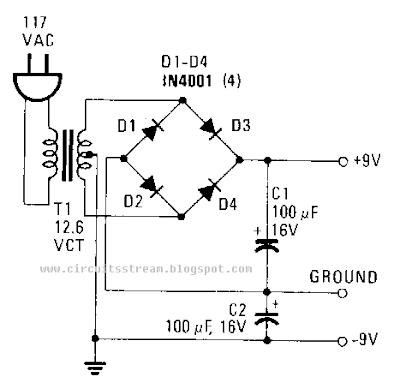
How to Build a Simple Power supply Circuit Diagram

To day i share this post how to Build a simple power-supply circuit diagram lets start . This simple power supply circuit diagram delivers plus and minus 9 V to replace two 9-V batteries. The rectifier circuit is actually two separate full-wave rectifiers fed from the secondary of the transformer. One full-wave rectifier is composed of diodes D1 and D2, which develop +9 V, and the other is composed of D3 and D4, which develop -9 V. 

Each .diode from every pair rectifies 6.3 Vac, half the secondary voltage, and charges the associated filter capacitor to the peak value of the ac waveform, 6.3 x 1.414 ~ 8.9 V. Each diode should have a PIV, Peak Inverse `Voltage, rating that is at least twice the peak voltage from the transformer, 2 x 8.9 ~ 18 V. The 1N4001 has a PIV of 50 V. I hope you are enjoy this circuit.

Simple Power supply Circuit Diagram

Simple Power supply Circuit Diagram


Read More..

Wednesday, August 14, 2013

100Khz Multiple Output Switching Power Supply Circuit Diagram

The 100Khz Multiple Output Switching Power Supply Circuit Diagram uses two VN4000A 400-V MOSPOWER FETs in a half-bridge power switch configuration. Outputs available are + 5 Vat 20 A and ±15 V (or ±12 V) at 1 A. Since linear three-terminal regulators are used for the low-current outputs, either ±12 V or ±15 V can be made available with a simple change in the transformer secondary windings. 

A TU94 switching regulator IC proVides pulse-width modulation control and drive signals for the power supply. The upper MOSPOWER FET, Q7. in the power switch stage is driven by a simple transformer drive circuit. The lower MOS. Q6, since it is ground referenced. is directly driven from the control !C.

 100Khz Multiple Output Switching Power Supply Circuit Diagram

100Khz Multiple Output Switching Power Supply Circuit Diagram

Read More..

Constructing your own Dual Power Supply Rise

Many times the hobbyist desires to have a simple, dual power supply for a project. Existing power supplies may be large either in power output or physical size. a simple Dual Power Supply is necessary.For most non-critical applications the best & simplest choice for a voltage regulator is the 3-terminal type.The three terminals are input, ground & output.

The 78xx & 79xx series can provide up to 1A load current & it have on chip circuitry to prevent damage in the event of over heating or excessive current. That is, the chip basically shuts down than blowing out. These regulators are cheap, simple to make use of, & they make it practical to design a method with plenty of P C Bs in which an unregulated supply is brought in & regulation is done locally on each circuit board.

This Dual Power Supply project provides a dual power supply. With the appropriate choice of transformer & 3-terminal voltage regulator pairs you can basically build a tiny power supply delivering up to amp at +/- 5V, +/- 9V, +/- 12V, +/-15V or +/-18V. You require to provide the middle tapped transformer and the 3-terminal pair of regulators you require:7805 & 7905, 7809 & 7909, 7812 & 7912, 7815 & 7915or 7818 & 7918.

The user must pick the pair they needs for his particular application.

Note that the + & - regulators do not must be matched: you can for example, use a +5v & -9V pair. However,the positive regulator must be a 78xx regulator, & the negative a 79xx. They have built in plenty of safety in to this project so it ought to give plenty of years of continuous service.

Transformer
This Dual Power Supply design makes use of a full wave bridge rectifier coupled with a centre-tapped transformer. A transformer with a power output rated at at least 7VA ought to be used. The 7VA rating means that the maximum current which can be delivered without overheating will be around 390mA for the 9V+9V tap; 290mA for the 12V+12V and 230mA for the 15V+15V. If the transformer is rated by output RMS-current then the worth ought to be divided by one.2 to get the current which can be supplied. For example, in this case a 1A RMS can deliver 1/(one.2) or 830mA.

Rectifier
They use an epoxy-packaged four amp bridge rectifier with at least a peak reverse voltage of 200V. (Note the part numbers of bridge rectifiers are not standardised so the number are different from different manufacturers.) For safety the diode voltage rating ought to be at least to times that of the transformers secondary voltage. The current rating of the diodes ought to be two times the maximum load current that will be drawn.

Filter Capacitor
The purpose of the filter capacitor is to smooth out the ripple in the rectified AC voltage. Theres dual amount of ripple is determined by the worth of the filer capacitor: the larger the worth the smaller the ripple.The two,200uF is an appropriate value for all the voltages generated using this project. The other consideration in choosing the correct capacitor is its voltage rating. The working voltage of the capacitor has to be greater than the peak output voltage of the rectifier. For an 18V supply the peak output voltage is one.4 x 18V, or 25V. So they have selected a 35V rated capacitor.

Regulators
The unregulated input voltage must always be higher than the regulators output voltage by at least 3V in order for it to work. If the input/output voltage difference is greater than 3V then the excess potential must be dissipated as heat. Without a heat sink three terminal regulators can dissipate about two watts. A simple calculation of the voltage differential times the current drawn will give the watts to be dissipated. Over two watts a heat sink must be provided. If not then the regulator will automatically turn off if the internal temperature reaches 150oC. For safety it is always best to make use of a small heat sink even in case you do not think you will need.

Stability
C4 & C5 improve the regulators ability to react to sudden changes in load current & to prevent uncontrolled oscillations.

Decoupling
The mono block capacitor C2 & C6 across the output provides high frequency decoupling which keep the impedance low at high frequencies.

LED
Two LEDs are provided to show when the output regulated power is online. You do not must make use of the LEDs in the event you do not require to. However, the LED on the negative side of the circuit does provide a maximum load to the 79xx regulator which they found necessary in the coursework of testing. The negative 3-pin regulators did not like a zero load situation. They have provided a 470R/0.5W resistors as the current limiting resistors for the LEDs.

Diode Protection
These protect chiefly against any back emf which may come back in to the power supply when it supplies power to inductive lots. They also provide additional short circuit protection in the case that the positive output is connected by accident to the negative output. If this happened the usual current limiting shutdown in each regulator may not work as intended. The diodes will short circuit in this case & protect the two regulators.

Dual Power Supply Schematic Diagram


Read More..

Saturday, August 10, 2013

Simple 0 30 Volts 2 5A Variable Power Supply Circuit Diagram

This is the Simple 0-30 Volts - 2-5A Variable Power Supply Circuit Diagram. This is a high quality power supply with a continuously variable stabilized output adjustable between 0 and 30VDC. the LM 723 is the heart of the power supply which drives the BD137 and then the 2N3055. The circuit provides short circuit protection. And has great stability at voltage changes. Drive the circuit with 24 Volts 3A from a transformer. the 2N3055 needs a good heat sink.

  0-30 Volts - 2-5A Variable Power Supply Circuit Diagram

 0-30 Volts - 2-5A Variable Power Supply Circuit Diagram
Read More..

Wednesday, August 7, 2013

0 30 Volt Power Supply

linear power supply, shown in the schematic, provides 0-30 volts, at one amp, maximum, using a discrete transistor regulator with op amp feedback to control the output voltage. The supply was constructed in 1975-6 & has a constant current mode that is used to recharge batteries.


With reference to the schematic, lamp, LP2, is a power on indicator. The other lamp (lower) lights when the unit reaches its preset current limit. R5, C2, & Q10 (TO-3 case) operate as a capacitor multiplier. The 36 volt zen-er across C2 limits the maximum supply voltage to the op amps supply pins. D5, C4, C5, R15, & R16 provide a tiny amount of negative supply for the op amps so that the op amps can operate down to zero volts at the output pins (pins 6). A more modern design might eliminate these four parts & use a CMOS rail-to-rail op-amp. Current limit is set by R3, D1, R4, R6, Q12, R10, & R13 providing a bias to U2 that partially turns off transistors Q9 & Q11 when the current limit is reached. R4 is a front panel potentiometer that sets the current limit, R22 is a front panel potentiometer that sets the output voltage (0-30 volts), & R11 is an internal trim-pot for calibration. The meter is a one milliamp meter with an internal resistance of 40 ohms. Switch S1 determines whether the meter reads 0-30 volts, or 0-1 amp.


A more new circuit might use a single IC regulator, such as the MC78XX, or MC79XX series, immediately after the half wave rectifier, to replace about 30 parts, or at least a high precision zen-er diode to replace D10 as the voltage reference. The LM4040 is such voltage reference & has excellent stability over temperature. IC regulators such as the MC78XX series may finally become obsolete as newer IC regulators are designed, however, discrete transistors, op-amps, & zeners are more generic, have an extended production lifespan, & permit the designer to demonstrate that they understands the principles of linear regulated power supply operation.
Read More..

Tuesday, August 6, 2013

Build a Positive And Negative Voltage Switching Supply

Build a Positive And Negative Voltage Switching Supply. An LT1172 generates positive and negative voltages from a 5-V input. The LT1172 is configured as a step-up converter. To generate the negative output, a charge pump is used. C2 is charged by the inductor when D2 is forward-biased and discharges into C4 when LT1172`s power switch pulls the positive side of C2 to ground. 

 Positive And Negative Voltage Switching Supply  Circuit Diagram

 Positive And Negative Voltage Switching Supply  Circuit Diagram
 
Read More..

Monday, August 5, 2013

Simple split power supply circuit Diagram

This circuit utilizes the quasi-complementary output stage of the popular LM380 audio power IC. The device is internally biased so that with no input the output is held midway between the supply rails Rl, which should be initially set to mid-travel, is used to nullify any inbalance in the output. 

Regulation of Vout depends upon the circuit feeding the LM380, but positive and negative outputs will track accurately irrespective of input regulation and unbalanced loads. 

The free-air dissipation is a little over 1 watt, and so extra cooling: may be required. The device is fully protected and will go into thermal shutdown if its rated dissipation is exceeded. Current limiting occurs if the output current exceeds 1 A. The input voltage should not exceed 20 V.

Simple split power supply circuit Diagram

Simple split power supply circuit Diagram

Read More..

Saturday, August 3, 2013

Panasonic Microwave Oven Inverter HV Power Supply

Nearly all Panasonic microwave ovens now use an Inverter, and are always labelled with “Inverter” on
the front.

The High Voltage Power Supply Unit (HV PSU)
The HV PSU measures 165mm x 105mm x 60mm and weighs 650g.
 At left is the control daughter board. In front of that on the main board are the opto-isolators for the control and status signals brought out to the green connector. Back left is the rectified mains filter choke. The mains rectifier and switching transistors can just be seen on the heatsink behind the transformer. The mains filter capacitor is at right rear. The HV rectifiers and filters (doubler) are right front – white wires are the HV output from the transformer. The green wire is for grounding the HV +ve. The two lugs t right are for connecting HV -ve and heater to the magnetron. The winding thatcan be seen on the transformer is the primary and is made from 3mm finely stranded wire.

Here’s a view of the control end: 


This is the high voltage end:


The circuit for the HV PSU is below 

Notes about the circuit:
1. Apart from the block diagram, there is no information on the Inverter cont(o)rol circuit. The circuit itself is centred on one large, unmarked IC, so no help there.
2. The control and status signals seem to be a digital stream (2-3v suggestsa 5V data stream). They are opto-isolated because the majority of the circuit is at mains potential  (**BEWARE**). The part that isn’t is at 4kV (*** REALLY BEWARE ***)
3. The mains input side is monitored for both current and (under) voltage. No indication of what the control circuit does with this information.
4. The mains filter capacitor (C702) is very small – only 4uF. In a “normal” switching supply, there is usually 220 or 470 uF in this position.
5. Q701 that does all the hard work is a very heavy duty IGBT – a GT60N90 - 900V @ 60 A. Q702 forms some sort of flywheel circuit. This circuit from a Toshiba IGBT application note looks similar:
6. The HV side has a full-wave doubler rectifier and is marked 4kV @  300mA. Unlike the classic microwave oven transformers (where one side of the winding is grounded), this means that the secondary must be well insulated from ground on both sides. A simple reconfiguration of the rectifier (replace the caps with diodes) into a bridge circuit should yield 2kV @ 600mA (depending on the diode ratings)
7. The HV filter capacitors are only 8200 pF each, effectively giving 4100pF in the doubler. Considering that the inverter runs at about 30kHz, the reactance is equivalent to that  of a 5uF capacitor at 50Hz.
8. The positive side of the HV is grounded, so it’s a –4kV supply. Don’t simply swap the ground from the positive to the negative to get a +4kV supply, as the core of the transformer is also connected to this ground trace and will suddenly rise to 4kV above ground with disastrous and potentially fatal results. Instead, reverse the polarity of the rectifier diodes to get +4kV.
Read More..

Build a 0 To 12V 1A Variable Power Supply Circuit Diagram

This 0- to 12-Vdc variable power supply uses an IC voltage regulator and a heavy-duty transformer to provide a reliable dc power supply. Looking at the schematic shown, you can sec that transformer Tl has a 120-V primary and a 28-V secondary. Filtered dc is fed to the input (pin 2) of the LM317T voltage regulator, IC, which keeps the voltage at its output constant (pin 3) regardless (within limitations) of the input voltage. 

Pin 1 of the LM317T is the adjustment pin. Varying the voltage on pin 1 (via PI) varies the output voltage. Diodes D5 through D7 and LEDs LI through L3 give an approximate indication of the output voltage. Each LED/diode path has a limiting resistor to limit the current to a level that is safe for the LED. 

 Build a 0 To 12V, 1A Variable Power Supply Circuit Diagram


Build a 0 To 12V, 1A Variable Power Supply Circuit Diagram
Read More..

Sunday, July 7, 2013

Low Ripple Regulated Power Supply

This circuit may be used where a high current is required with a low ripple voltage (such as in a high powered class AB amplifier when high quality reproduction is necessary ).
Low Ripple Power Supply Circuit Diagram
PARTS LIST
R12.2KΩ 1W
R256Ω 1W
R31oKΩ 1W
C11000µF 63V
C2100µF 50V
C3470µF 50V
D1, D2, D3, D46A Bridge Rectifier
D5500mA Zener Diode (see description)
Q12N3055
Q22N3054
Q1, Q2, and R2 may be regarded as a power darlington transistor. D5 and R1 provide a reference voltage at the base of Q1. D5 should be chosen thus:
D5=Vout-1.2
C2 can be chosen for the degree of smoothness as its value is effectively multiplied by the combined gains of Q1/Q2, if 100µF is chosen for C2, assuming minimum hef for Q1 and Q2,
C=100×15(Q1)×25(Q2)
=37000µF.
Read More..

Friday, July 5, 2013

Constructing a Universal Power Supply using LM317 Rise

This is a basic,  Universal Power Supply voltage regulator circuit using an LM317, 3-terminal regulator in a TO-220package. The Universal Power Supply output voltage can be set to anywhere in the range one.5V to 30V by selecting resistances. By using a potentiometer, R2, as of the resistors you can dial up the output voltage wanted. Either AC or DC input can be supplied to the PCB by a socket or terminal block. Connection can be either way around. This is because they have provided a bridge rectifier on board. The input DC voltage to the regulator must be at least two.5V above the necessary output voltage. An off/on switch is provided.

For lots of applications (say 12V at 60mA) a heat sink wont be required. The LM317 will provide slightly higher output voltages than 30 volts. However, for most hobbyists over 30V wont be needed. So to make a small PCB they have used some electrolytic capacitors rated to 35 volts. To be safe for continuous operation the maximum input DC voltage to the regulator ought to not be over 33V. With a two.5V to three.0V drop across the regulator this will give a regulated output of 30V. You can draw up to one.5A from the LM317. In case you need higher then use an LM338T rated to 5A.

When outside capacitors are used with any IC regulator it is lovely practice to add protection diodes to prevent the capacitors discharging back in to the regulator in the event of abnormal operating conditions, like a sudden short circuit on the input or the output, or a back emf from an inductive load. That is the function of D one and D Two.

The worth of R1 can range anywhere from 120R to 1200R However, circuits from most other sources settle on using either 220R or 250R. They have used 240R or 250R. The voltage drop across R1is one.25V for all values, and this is the key to the design. one.25V is the reference voltage of the regulator. Whatever current flows through R1 also flows through R2, and the sum of the voltage drops across R1 and R2 is the output voltage. (Additional current Id also flows in R2 but it is usually 50uA so is negligible.)

The design formula are:
VOUT = 1.25 (1 + R2/R1) volts, or alternatively
R2/R1 = (VOUT/1.25) - 1

So in case you know VOUT & R1 is 250R then you can calculate R2. In case you find that the 5K potentiometer used forR2 does not give you the degree of fine control over the voltage output range that you need then you can use these formula to fine-tune R1 & R2 to better suited values.


Universal Power Supply Schematic Diagram


Read More..

Friday, April 12, 2013

230 V AC To 400 V DC Power Supply Circuit Diagram


Description

               A lot of students are who dont know the highest method to convert 230 volt AC to 400 DC. So today i am printed   230 V AC to 400 V DC circuit diagram on my blog. Working idea of this circuit diagram is very simple. You already knew the working theory of a bridge rectifier. This circuit is related as bridge rectifier and the working concept can be related. The fuse is used to supply safety to the circuit, if the current is greater than 1 A.

Parts List

Component No:Value
F11 A
B1IN4007 
C1470MF/450V 
V1230 V AC 
Read More..